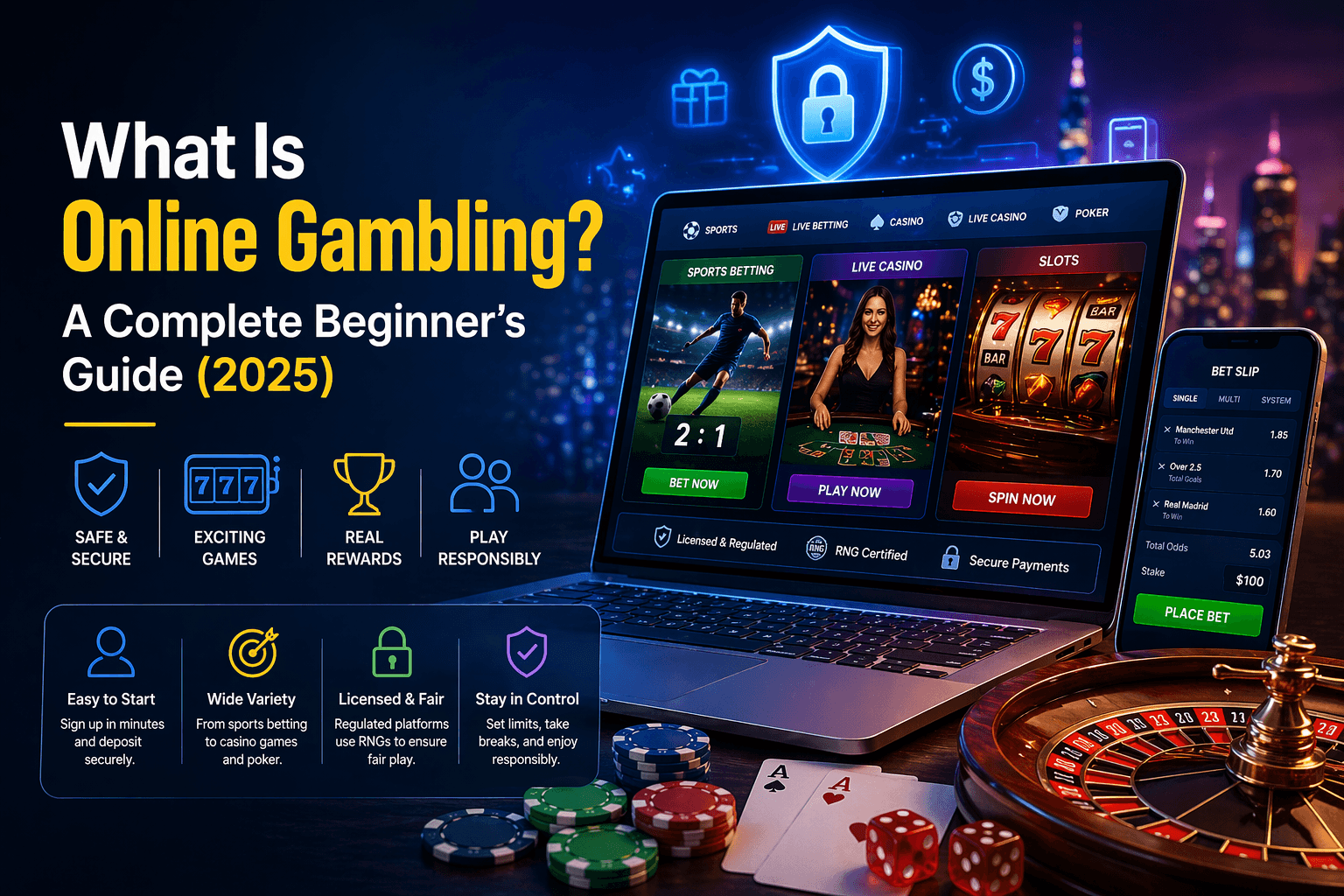
You’ve heard the term, maybe seen the ads, or had a friend mention it — but what exactly is online gambling, and how does it work? If you’re curious but don’t know where to start, you’re in the right place. This guide breaks everything down in plain English: no jargon, no assumptions, just clear answers for anyone starting from zero.
Table Of Contents
1. Introduction — Why Millions of People Gamble Online
Online gambling has quietly become one of the world’s largest entertainment industries. According to market research, the global online gambling market was valued at approximately $78–95 billion in 2024 and is projected to nearly double to over $150 billion by 2030, growing at a compound annual rate of around 11–12%. To put that in perspective, it’s already bigger than the global music industry.
So why do so many people do it?
The honest answer is a mix of things: convenience, entertainment, and the timeless thrill of a wager. You don’t need to dress up, drive to a casino, or wait for a poker table to open. You can place a sports bet in 30 seconds from your couch, spin a slot at midnight, or join a live blackjack table from your phone on a lunch break. Smartphones now account for close to 80% of all online gambling activity worldwide.
Beyond convenience, there’s a social element too. Online poker puts you against real players from across the globe. Live casino tables are hosted by real dealers via video stream. And sports betting turns watching a game into something with genuine skin in the game.
None of this means online gambling is without risk — it absolutely carries risks, which we’ll cover honestly in the sections below. But understanding what it is and how it works is the necessary first step before you decide whether it’s something you want to explore.
2. How Online Gambling Works — Simple and Jargon-Free
At its core, online gambling is straightforward: you wager real money (or sometimes virtual currency) on an outcome, and if your prediction or result is correct, you win money. If it’s wrong, you lose your stake.
Here’s the basic flow of how it works in practice:
Step 1 — Choose a platform. You sign up with a licensed online casino, sportsbook, or poker site. This involves creating an account and verifying your identity (age verification is legally required in most regulated markets).
Step 2 — Deposit money. You add funds to your account using a payment method — debit/credit card, bank transfer, e-wallet (like PayPal or Skrill), or even cryptocurrency on some platforms. Most sites have a minimum deposit, often as low as $5–$10.
Step 3 — Choose your game or bet. You pick what you want to play — a slot machine, a poker hand, a sports match, etc.
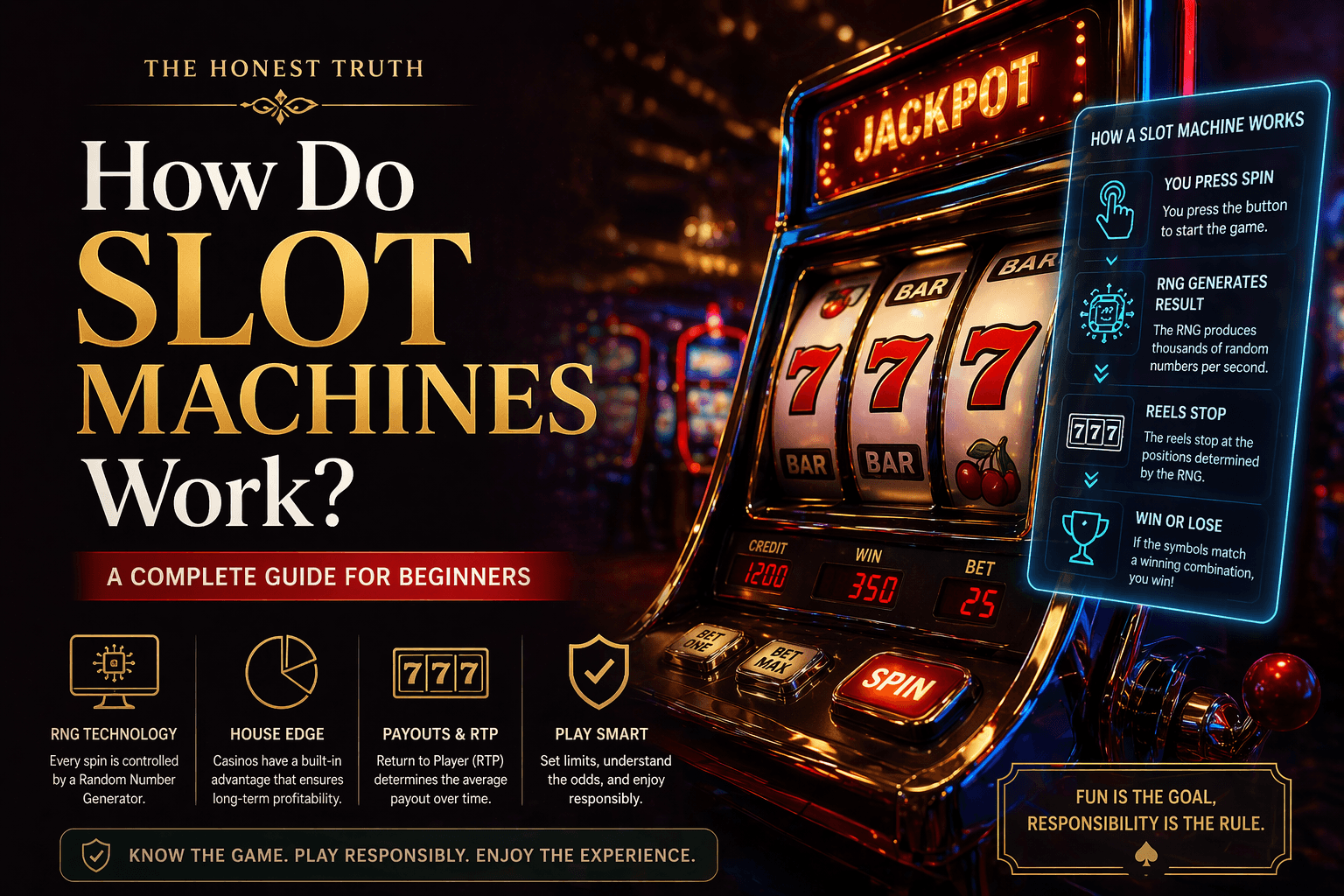
Step 4 — Play and wait for the outcome. The result is determined either by a Random Number Generator (RNG) for most casino games, by real-world events (sports results), or by other players (poker).
Step 5 — Withdraw winnings. If you win, the money goes into your account balance. You can keep playing or request a withdrawal back to your bank account or payment method.
What is an RNG?
A Random Number Generator is a piece of software that produces completely random results thousands of times per second. Every spin of a slot machine, every card dealt in online blackjack, every roulette wheel outcome — it’s all determined by an RNG. Licensed casinos have their RNGs independently tested by organisations like eCOGRA or iTech Labs to ensure they’re truly random and not rigged. Think of it as a constantly rolling digital dice that no one — not even the casino — can predict or control.
3. The Main Types of Online Gambling
Online gambling is not one thing. It’s a broad category that includes very different activities. Here’s a plain-English breakdown:
Casino Games
This is what most people picture — digital versions of the games you’d find on a casino floor.
- Slots (Pokies): The most popular type. You spin reels and try to land matching symbols across paylines. Modern online slots come with themes, bonus rounds, free spins, and jackpots that can reach millions of dollars. They’re completely luck-based and require no skill.
- Blackjack: A card game where you try to beat the dealer by getting a hand value closer to 21 without going over. Strategy matters here — skilled play significantly improves your odds.
- Roulette: A spinning wheel with numbered red and black slots. You bet on where a ball will land. Simple to learn, and there are different versions (European, American, French) with slightly different odds.
- Baccarat: A simple card game popular in Asia. You bet on whether the “Player” hand or the “Banker” hand wins. No decisions required — just pick a side.
- Live Casino: A relatively recent innovation where real human dealers run games (blackjack, roulette, baccarat) in a studio, streamed live via video. You play in real time through your device. It bridges the gap between the convenience of online and the atmosphere of a physical casino.
Sports Betting
You bet on the outcome of sporting events — football matches, cricket, horse racing, tennis, basketball, and hundreds more. You can bet on simple outcomes (who wins), specific events within a game (first goalscorer, total points), or accumulate multiple bets into a “parlay” or “accumulator” for higher potential returns. Sports betting is the largest single segment in online gambling, accounting for over 50% of the global market in 2024.
Online Poker
Poker is played against other real players, not the house. The casino (or platform) takes a small cut from each pot called the “rake.” Online poker offers cash games, where you can join or leave anytime, and tournaments, where you pay an entry fee and compete for a prize pool. Because you’re playing other humans, skill plays a much larger role over time than in casino games. Platforms like PokerStars have millions of users globally.
Online Lottery and Bingo
Digital versions of traditional lottery draws and bingo halls. Lottery sites let you buy tickets for major international draws (Powerball, EuroMillions). Online bingo has become particularly popular in the UK, combining gameplay with chat features that create a genuine community feel.
Esports and Fantasy Sports Betting
A newer but fast-growing category: betting on professional video game tournaments (League of Legends, Counter-Strike, Dota 2) or entering daily fantasy sports contests where you draft a team of real athletes and score points based on their real-world performance.
4. How Online Casinos Make Money — The House Edge Explained
This is the most important concept for any beginner to understand, and it’s simpler than it sounds.
Every casino game is mathematically designed so that the casino has a built-in advantage over time. This is called the house edge. It doesn’t mean you’ll always lose — you can absolutely win in a single session — but over thousands and millions of spins or bets, the house will always come out ahead. That’s how casinos stay in business.
A Simple Example
Say a casino game has a 5% house edge. For every $100 wagered across all players over time, the casino expects to keep $5 and return $95 in winnings. On any individual bet, you might win or lose. But zoom out over millions of bets and the 5% reliably accrues to the casino.
Return to Player (RTP)
The flip side of the house edge is the Return to Player (RTP) percentage. It simply tells you how much of all the money wagered on a game is returned to players as winnings over the long run.
House Edge + RTP = 100%
So a game with a 96% RTP has a 4% house edge.
If a slot has a 96% RTP, then for every $100 wagered on it over thousands of spins, it pays back $96 to players on average.
House Edge by Game Type
| Game | Typical House Edge |
|---|---|
| Blackjack (with basic strategy) | 0.5% |
| Baccarat | 1.06% (banker bet) |
| European Roulette | 2.7% |
| American Roulette | 5.26% |
| Online Slots | 2%–10% (average ~4%) |
| Keno / Scratch Cards | 20–40%+ |
Blackjack consistently offers the best odds — a skilled player using “basic strategy” faces a house edge of only around 0.5%. Online slots are the most popular, but they carry a higher house edge than most table games.
One Important Caveat
RTP is a long-run statistical average, not a guarantee for any single session. You could spin 50 times on a 96% RTP slot and lose every one. Or you could win a jackpot on your third spin. The numbers only reliably play out across hundreds of thousands of spins aggregated across all players. Short-term results are highly random.
How Sports Betting Makes Its Money
Sportsbooks don’t use an RTP model — instead, they build their profit into the odds they offer. If the true probability of an event is 50/50, a sportsbook won’t offer even money (2.00 in decimal odds). They’ll shade it to something like 1.91/1.91, keeping a margin of around 4–5%. This is called the vig or vigorish (sometimes called the “overround”).
5. Is Online Gambling Legal? — A Global Overview
This is where things get complicated, because there is no global answer. Legality varies dramatically by country — and sometimes by region within a country.
Broadly, the world’s approach to online gambling falls into three camps:
✅ Fully Regulated (Legal with Licensing)
Between 70 and 80 countries have established legal, regulated online gambling frameworks where licensed operators can legally offer services to players. Key examples include:
- United Kingdom: Home to one of the world’s strictest and most respected regulatory bodies, the UK Gambling Commission (UKGC), which licenses all operators and enforces strong consumer protections.
- Malta: A European hub for online gambling licensing. The Malta Gaming Authority (MGA) licence is widely respected internationally.
- Most of the EU: Countries like Germany, Spain, Italy, Sweden, and Denmark have established regulated online gambling markets, each with their own licensing authorities.
- United States: A patchwork system. Sports betting is legal in 39+ states. Online casino gambling is more restricted — currently available in around 7 states including New Jersey, Pennsylvania, Michigan, and Connecticut, with more expected to follow.
- Canada: Regulated provincially. Ontario has the most developed private operator market, launched in 2022.
- Australia: Sports betting is legal and regulated. Online casino games, however, are prohibited for Australian players under the Interactive Gambling Act.
- Colombia, Mexico, Brazil: Increasingly regulated markets in Latin America.
⚠️ Grey Markets (Unregulated but Not Explicitly Illegal)
Around 40–50 countries have no specific online gambling legislation. In these regions, it’s neither clearly legal nor clearly illegal — the law simply hasn’t addressed it yet. Players in these countries often access offshore sites with no specific prohibition.
❌ Prohibited (Illegal)
Around 70 countries prohibit online gambling, including:
- China: All forms of online gambling are illegal except state-run lotteries. Enforcement is strict.
- Saudi Arabia, UAE (largely): Prohibited on religious grounds, though the UAE issued its first iGaming licence in 2024 in a notable shift.
- Japan: Illegal under the Penal Code, with restrictions tightened further in 2025.
- India: A complex mix — gambling laws are set state-by-state, with some states permitting games of skill (like poker and rummy) online while others prohibit all gambling.
The key takeaway: always check the laws specific to your country or state before gambling online. Playing on an unlicensed site in a jurisdiction where it’s prohibited carries legal risk and — equally importantly — offers no consumer protection if something goes wrong.
6. Key Terms Every Beginner Should Know — A Mini Glossary
You’ll encounter this vocabulary constantly. Here’s what it all actually means:
| Term | What It Means |
|---|---|
| House Edge | The casino’s built-in mathematical advantage on every game |
| RTP (Return to Player) | The percentage of all wagered money paid back to players over time |
| RNG (Random Number Generator) | Software that produces truly random outcomes for each game round |
| Wagering Requirement | A condition on bonuses: you must bet the bonus amount X times before withdrawing winnings |
| Bonus / Welcome Offer | Extra money or free spins given by a casino, usually on your first deposit |
| Free Spins | Bonus slot spins provided by the casino at no extra cost to you |
| Withdrawal | Taking money out of your casino account back to your bank or payment method |
| Jackpot | A large prize that can be won — either fixed (set amount) or progressive (grows over time) |
| Progressive Jackpot | A jackpot that grows with every bet placed by all players across a network, sometimes reaching millions |
| Variance / Volatility | How often and how much a slot pays out — high variance = rare but big wins; low variance = frequent but smaller wins |
| Odds | In sports betting, the number that determines your payout. Decimal odds of 2.00 means you double your stake if you win |
| Vig / Overround | The sportsbook’s built-in profit margin on odds |
| Accumulator / Parlay | Combining multiple bets into one — all must win, but the potential payout multiplies |
| Live Betting / In-Play | Placing bets on a sporting event while it’s already in progress |
| KYC (Know Your Customer) | Identity verification process — casinos are legally required to verify your age and identity |
| Responsible Gambling Tools | Features like deposit limits, time limits, and self-exclusion offered by licensed casinos |
| GGR (Gross Gaming Revenue) | The casino’s revenue after paying out player winnings — the industry’s key financial metric |
| iGaming | A broad term for internet-based gambling, encompassing casinos, sports betting, and poker |
7. Is Online Gambling Safe?
The honest answer is: it depends on where you play. The difference between a licensed, regulated platform and an unlicensed one is enormous.
Signs of a Safe, Legitimate Online Casino
- Holds a licence from a recognised authority — look for logos from the UKGC (UK Gambling Commission), MGA (Malta Gaming Authority), Gibraltar Regulatory Authority, or your country’s relevant body.
- Uses SSL encryption — the padlock symbol in your browser confirms your financial data is encrypted.
- Independent RNG auditing — look for certification from eCOGRA, iTech Labs, or BMM Testlabs.
- Clear terms and conditions — particularly around bonuses, withdrawals, and wagering requirements.
- Fast, reliable withdrawals — legitimate casinos pay out winnings promptly, typically within 1–5 business days.
- Responsible gambling tools — licensed casinos are legally required to offer deposit limits, cooling-off periods, and self-exclusion options.
- Verified customer reviews — platforms like Trustpilot and AskGamblers aggregate player experiences.
Red Flags to Watch Out For
- No visible licence number (or a licence from an obscure, unverifiable jurisdiction)
- Unrealistically generous bonuses with no clear terms
- Slow or refused withdrawals — this is the single biggest warning sign
- No identity verification required to withdraw (this is actually a red flag, not a benefit)
- Pressure tactics or aggressive bonus pop-ups
- No responsible gambling section on the website
What About Your Financial Information?
Reputable licensed casinos use the same 128-bit or 256-bit SSL encryption that your bank uses. Your card details are processed through established payment gateways and are not stored by the casino directly. The key risk is choosing an unlicensed platform, where consumer protection essentially doesn’t exist.
8. Responsible Gambling — Know Before You Start
This section matters more than any other in this guide. Online gambling can be entertainment, but it carries genuine risks that are worth understanding clearly before you start.
The Core Reality
The house edge means that if you gamble long enough, you will lose money over time. Gambling should be thought of as a cost of entertainment — like a cinema ticket or a night out — not as a way to make money or solve financial problems. Anyone who tells you otherwise is wrong.
Warning Signs of a Problem
Gambling can become harmful when it stops being recreational and starts affecting your wellbeing. Be honest with yourself if you notice:
- Chasing losses (gambling more to try to win back what you’ve lost)
- Spending more than you can afford to lose
- Hiding gambling from family or friends
- Gambling to escape stress, anxiety, or depression
- Thinking about gambling constantly
- Borrowing money to gamble
Practical Tools to Stay in Control
Every licensed casino is required to offer these — use them:
- Deposit limits: Set a daily, weekly, or monthly cap on how much you can deposit.
- Loss limits: Cap how much you can lose in a given period.
- Session time limits: Set alerts or automatic logouts after a defined period.
- Reality checks: Pop-up reminders at regular intervals showing how long you’ve been playing and your net result.
- Cooling-off periods: Temporarily lock your account for 24 hours, a week, or longer.
- Self-exclusion: Permanently close your account and be blocked from opening new ones. In the UK, the national self-exclusion scheme is called GAMSTOP.
The Golden Rules Before You Start
- Set a budget before you play — decide in advance the maximum you’re willing to lose, and treat it as spent the moment you deposit it.
- Never gamble with money you can’t afford to lose — rent, bills, savings, and everyday expenses are off-limits.
- Never chase losses — if you’ve hit your limit, stop. The next spin or bet doesn’t “know” you’re due a win.
- Take regular breaks — time distorts quickly when gambling online.
- Don’t gamble under the influence — alcohol and gambling is a well-documented combination that leads to poor decisions.
- Treat bonuses sceptically — read the wagering requirements before accepting any offer.
Help Is Available
If gambling is causing problems for you or someone you know, free, confidential support is available:
- GamCare (UK): gamcare.org.uk | Helpline: 0808 8020 133
- Gamblers Anonymous: www.gamblersanonymous.org (global chapters)
- National Problem Gambling Helpline (US): 1-800-522-4700
- BeGambleAware (UK): begambleaware.org
There is no shame in reaching out. These organisations exist precisely because gambling-related harm is common and treatable.
Final Thoughts
Online gambling is a vast, increasingly sophisticated industry that attracts hundreds of millions of people for legitimate reasons: entertainment, excitement, and the social experience of games and sport. Understanding how it actually works — the house edge, the types of games, the legal landscape, and the safety signals — puts you in a much stronger position than the average beginner.
The most important things to carry away from this guide are simple: always play on licensed platforms, always set a budget, and always treat gambling as entertainment rather than income. If you do those three things, you’ll have a far better experience than the majority of people who start without any background knowledge at all.
Always gamble responsibly. If you or someone you know is struggling with gambling, please reach out to a helpline in your country.