
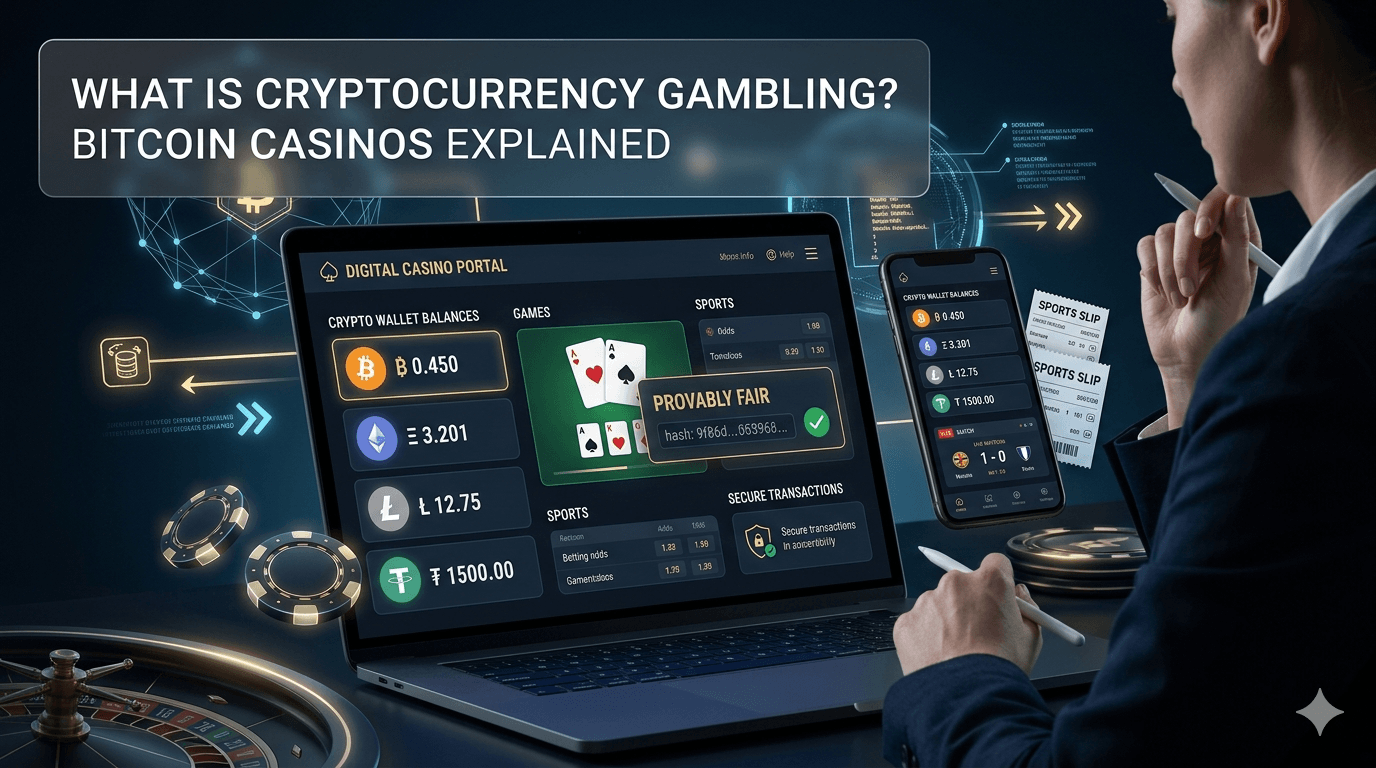
A decade ago, the idea of gambling with digital currency that exists only on a blockchain ledger would have sounded like science fiction. Today, Bitcoin casinos process billions of dollars in wagers annually, players in over 100 countries are using Ethereum and Litecoin to fund their casino accounts, and an entirely new concept — provably fair gambling — has emerged that allows players to mathematically verify that they weren’t cheated, without trusting the casino at all.
Crypto gambling is one of the fastest-growing segments of the online casino industry. It is also one of the most misunderstood — surrounded by genuine innovation, real advantages, significant risks, and more than a few outright scams.
This guide cuts through the noise. Whether you’re a crypto-curious casino player or a crypto enthusiast wondering about gambling applications, here is everything you need to know.
Table Of Contents
1. What Crypto Gambling Actually Is
Crypto gambling refers to any form of online gambling where cryptocurrency — Bitcoin, Ethereum, Litecoin, or others — is used as the primary medium for deposits, wagers, and withdrawals, instead of (or alongside) traditional fiat currencies like INR, USD, or EUR.
On the surface, a crypto casino looks and functions identically to any other online casino. There are slot machines, table games, poker rooms, sports betting, and live dealer tables. The difference lies entirely in the financial layer underneath: instead of depositing via UPI, bank transfer, or a credit card, you send cryptocurrency directly from your personal wallet to the casino’s wallet address. Winnings are paid back to your wallet in the same cryptocurrency.
Some platforms are crypto-exclusive — they accept no fiat currencies at all. Others are hybrid platforms that accept both traditional payment methods and crypto. A growing number of established online casinos that built their businesses on fiat banking have added cryptocurrency options as an additional payment method.
There is also a distinct category called crypto-native casinos — platforms built specifically around blockchain technology that incorporate features unavailable in traditional casinos, most notably provably fair gaming (covered in detail in Section 6).
The crypto gambling ecosystem also extends beyond casinos into crypto sports betting platforms, crypto poker rooms, and blockchain-based prediction markets where users bet on real-world outcomes using smart contracts with no centralised operator at all.
Understanding which type of platform you’re engaging with — hybrid fiat/crypto, crypto-exclusive, or fully blockchain-native — is the first step to making an informed decision.
2. How Bitcoin Transactions Work in Casinos
To understand crypto gambling, you need a working understanding of how cryptocurrency transactions actually function. You don’t need to understand blockchain technology at a deep technical level — but the basics matter.
The wallet system
Cryptocurrency is held in a digital wallet — a piece of software (a mobile app, desktop application, browser extension, or hardware device) that stores the cryptographic keys that control your cryptocurrency holdings. Your wallet has a public address — like an account number — that others can send funds to.
When you deposit at a Bitcoin casino, the process works like this:
- You log into your casino account and navigate to the deposit section
- The casino provides you with a unique Bitcoin wallet address (or a QR code)
- You open your own Bitcoin wallet app and send the desired amount to that address
- The transaction is broadcast to the Bitcoin network and begins being verified
- After a set number of confirmations (typically 1–6 for Bitcoin, depending on the casino), the funds appear in your casino account
- You play, win or lose, and your remaining balance can be withdrawn back to your personal wallet
Confirmations and transaction time
Each Bitcoin transaction must be verified by the network — a process called confirmation. Each block added to the Bitcoin blockchain after your transaction counts as one confirmation. Most casinos require 1–3 confirmations before crediting your account. With Bitcoin’s average block time of approximately 10 minutes, a deposit requiring 3 confirmations takes roughly 30 minutes.
This is slower than instant UPI or card deposits — a real practical difference worth knowing about. Some cryptocurrencies (Litecoin, Solana, Ripple) offer much faster confirmation times, which is part of why multiple cryptocurrencies have emerged as preferred choices for gambling transactions.
Transaction fees
Every blockchain transaction incurs a small network fee paid to the miners or validators who process it. Bitcoin fees vary based on network congestion — during high-traffic periods, they can be significant. Ethereum fees (called “gas”) can be particularly volatile. Cheaper alternatives like Litecoin, Bitcoin Cash, and Solana are popular for gambling partly because of their lower transaction costs.
Self-custody vs. exchange wallets
A critical distinction for crypto gamblers: funds in your personal, self-custody wallet (where you control the private keys) are genuinely yours. Funds held on a centralised exchange (Coinbase, Binance, WazirX) are technically held by the exchange on your behalf. Using an exchange wallet to deposit at a casino adds an extra layer of counterparty risk — if the exchange freezes withdrawals (as several have done historically), you may be unable to fund or withdraw from your casino account. Most experienced crypto users recommend using a personal wallet for gambling transactions.
3. The Advantages — Anonymity, Speed, and Global Access
Crypto gambling has attracted a large and growing user base for concrete reasons, not just novelty. Here are the genuine advantages it offers over traditional online gambling.
Enhanced Privacy and Anonymity
Traditional online casinos require you to complete KYC (Know Your Customer) verification — submitting a government ID, proof of address, and sometimes source-of-funds documentation. This information is stored in the casino’s database and, in regulated markets, may be shared with regulators and government bodies.
Crypto-only casinos frequently require no identity verification at all, or minimal verification. Your wallet address is pseudonymous — transactions are visible on the public blockchain, but the address is not linked to your real identity unless you deliberately connect them. For players in jurisdictions where online gambling exists in a legal grey zone (including much of India), this anonymity is a significant practical consideration.
Important nuance: True anonymity requires careful management. Most people purchase cryptocurrency through exchanges that require full KYC — creating a link between their identity and their wallet address. Using privacy-focused cryptocurrencies (Monero) or mixing services can extend anonymity further, but these also attract additional regulatory scrutiny.
Faster Withdrawals
The withdrawal bottleneck is one of the most frustrating aspects of traditional online gambling. Pending periods of 24–72 hours, bank processing delays, and compliance reviews can delay access to winnings for days.
Crypto withdrawals can be processed in minutes. Once a casino approves a withdrawal, the transaction is broadcast to the blockchain and typically arrives in your wallet within 10–60 minutes (depending on the cryptocurrency). There are no banking hours, no payment processor delays, no weekend holds.
Borderless Access
Traditional online gambling is constrained by banking infrastructure — payment processors and card networks often block transactions to gambling merchants, and many banks in countries like India refuse gambling-related transfers. Cryptocurrency bypasses this entirely. A Bitcoin transaction moves from wallet to wallet regardless of where either party is located, without passing through any financial intermediary that can block it.
This makes crypto gambling genuinely global in a way that fiat gambling cannot be — accessible to players in countries with restrictive banking environments, without VPNs or workarounds.
Lower Fees (on the Right Currencies)
Traditional payment methods come with fees at multiple stages — processing fees, currency conversion fees, withdrawal fees. On efficient blockchain networks (Litecoin, Solana, Bitcoin Cash), transaction fees are fractions of a cent. Even accounting for crypto-specific costs, the total fee burden of crypto gambling is often lower than traditional payment methods for high-volume players.
Provably Fair Gaming
This is unique to crypto and has no equivalent in traditional gambling — covered in full in Section 6.
4. The Risks — Volatility, Regulation Gaps, and Scam Sites
The advantages of crypto gambling are real. So are the risks. A complete picture requires addressing both.
Cryptocurrency Volatility
The most significant risk unique to crypto gambling is price volatility. Bitcoin’s value can move 10–20% in a single day during volatile market periods. If you deposit 0.01 BTC when Bitcoin is worth $60,000 (approximately ₹50,000) and the price drops 20% before you withdraw, your winnings are worth 20% less in fiat terms — even if you made a net gambling profit.
This cuts both ways — the value of your holdings can also increase while you’re playing. But volatility is a risk factor that simply doesn’t exist with fiat currency gambling, and it compounds the inherent risk of gambling with market risk on top.
Some crypto casinos offer “stablecoin” gambling — using cryptocurrencies like USDT (Tether) or USDC that are pegged 1:1 to the US dollar. This eliminates volatility entirely while retaining the other advantages of crypto transactions. For risk-averse players who want crypto’s practical benefits without the price exposure, stablecoins are the most sensible approach.
Regulation Gaps and Lack of Consumer Protection
Traditional licensed casinos operate under strict regulatory frameworks — they are required to segregate player funds, maintain fair game certification, honour withdrawals within defined timeframes, and provide responsible gambling tools. Regulatory bodies like the UK Gambling Commission have real enforcement power, and players have formal avenues for complaints and disputes.
Most crypto casinos operate under minimal regulation or entirely without licences. When a dispute arises — a withdrawal refused, a bonus term applied unfairly, an account closed without explanation — players have limited formal recourse. There is no regulatory ombudsman for an unlicensed Bitcoin casino operating from a jurisdiction with no oversight.
Reputable crypto casinos hold licences from jurisdictions like Curaçao, Malta, or Gibraltar — and while these provide some level of oversight, they are significantly less robust than UK or Swedish regulation. The absence of any licensing at all is a major red flag.
Scam Sites and Exit Scams
The combination of anonymity, minimal regulation, and cryptocurrency’s irreversible transactions makes the crypto gambling space attractive to fraudulent operators. “Exit scams” — where a platform accumulates player deposits and then disappears — are a documented risk. Unlike a credit card chargeback or a bank transfer dispute, a cryptocurrency transaction cannot be reversed once confirmed.
Identifying a trustworthy crypto casino requires checking community reputation (forums like Reddit’s r/onlinegambling, Bitcointalk), reviewing licence information carefully, checking whether games carry certified RTP audits from independent testing labs (eCOGRA, iTech Labs), and assessing the transparency of ownership and operation.
Responsible Gambling Gaps
Because many crypto casinos operate without formal licensing and without KYC, they also operate without many of the responsible gambling tools mandatory on licensed platforms. No deposit limits. No self-exclusion. No age verification. For vulnerable players, the reduced friction of anonymous access — combined with the absence of safety nets — creates a genuinely higher risk environment.
5. Which Cryptocurrencies Are Accepted at Casinos?
The cryptocurrency landscape at online casinos has expanded significantly beyond Bitcoin. Here is a guide to the major currencies and their relative merits for gambling use.
Bitcoin (BTC)
The original and most widely accepted cryptocurrency at online casinos. Recognised globally, highly liquid, and universally trusted. The main practical drawbacks for gambling are transaction speed (10+ minutes per confirmation) and fees that can be high during network congestion. Bitcoin remains the default choice for most crypto gamblers.
Ethereum (ETH)
The second-largest cryptocurrency by market cap and the backbone of most blockchain-based applications. Faster than Bitcoin (roughly 12–15 seconds per block), and its smart contract functionality enables blockchain-native casino games and decentralised applications. Gas fees can be high during peak network usage — a practical drawback for smaller gambling transactions.
Litecoin (LTC)
Created specifically as a faster, cheaper version of Bitcoin. Block times of approximately 2.5 minutes and very low fees make Litecoin one of the most practical cryptocurrencies for gambling transactions. Widely accepted, fast, and cost-effective — a popular choice for frequent depositors.
Ripple (XRP)
Extremely fast settlement times (3–5 seconds) and very low fees make XRP operationally attractive for gambling. Less widely accepted than Bitcoin, Ethereum, or Litecoin, but increasingly available on major platforms.
Bitcoin Cash (BCH)
A Bitcoin fork designed to address Bitcoin’s scalability limitations with larger block sizes and lower fees. Faster and cheaper than Bitcoin for routine transactions. A reasonable practical alternative, though with a smaller community and fewer accepting casinos.
Tether (USDT) and USD Coin (USDC) — Stablecoins
Not a cryptocurrency in the speculative sense — these are stablecoins pegged to the US dollar. USDT (Tether) is the most traded cryptocurrency by volume globally. For gambling purposes, stablecoins offer all the transaction advantages of crypto (speed, borderless access, lower fees) without any volatility risk. Increasingly the preferred choice for serious crypto gamblers who want predictable bankroll management.
Solana (SOL)
One of the fastest blockchain networks available — processing thousands of transactions per second with near-zero fees. A growing number of crypto casinos and blockchain gaming applications are building on Solana for this reason. Less established in the gambling space than Bitcoin or Ethereum but growing rapidly.
Dogecoin (DOGE) and Other Altcoins
A handful of casinos accept Dogecoin and other smaller cryptocurrencies, mostly as a marketing gesture toward their communities. Practical utility for gambling is limited, and liquidity considerations make them less suitable for large transactions.
6. Provably Fair Gambling — What It Means and How to Verify It
Provably fair gambling is the most genuinely innovative concept to emerge from the crypto gambling space — and it has no equivalent anywhere in traditional gambling.
In a standard online casino, you have no independent way to verify that the outcome of a game was truly random and unmanipulated. You trust the operator’s word and the third-party audits conducted by testing labs. These audits are legitimate and important, but they are periodic snapshots — not real-time verification of every individual game outcome.
Provably fair changes this fundamentally. It uses cryptographic hashing — the same mathematical principles that secure blockchain transactions — to allow players to verify, after every single bet, that the outcome was predetermined before their bet was placed and could not have been altered to disadvantage them.
How It Works — The Basic Mechanism
The provably fair system uses three components:
Server Seed: A random string of characters generated by the casino before the game begins. The casino hashes this seed (processes it through a mathematical function called SHA-256 that produces a fixed-length output) and shows you the hashed version before you play. Because hashing is a one-way function, you cannot reverse the hash to determine the original seed.
Client Seed: A random string generated by your browser or provided by you. You can change this whenever you want.
Nonce: A number that increases by 1 with every bet you place, ensuring each bet produces a unique outcome.
When you place a bet, the game outcome is determined by combining the server seed, client seed, and nonce through a mathematical formula. After the bet is resolved, the casino reveals the original unhashed server seed.
Verification: You can now independently verify — using the same mathematical formula — that the outcome was determined by those three inputs before you played. If the casino had tried to alter the outcome after seeing your bet, the server seed would produce a different hash from the one shown to you beforehand. The maths makes manipulation cryptographically impossible.
What This Means for Players
A provably fair system means you never have to simply trust a crypto casino’s integrity on individual outcomes. You can verify every single hand, every spin, every dice roll — after the fact, using publicly available tools. This is a paradigm shift from the trust-based model of traditional online gambling.
Most legitimate crypto casinos that offer provably fair games provide a verification tool directly in the game interface or on their website. You enter the server seed, client seed, and nonce, and the tool calculates and displays what the result should have been.
Important Caveat
Provably fair applies to the randomness of individual outcomes — it does not guarantee that a casino will honour withdrawals, apply bonus terms fairly, or operate ethically in other respects. A casino can be provably fair in its game mechanics and still be a problematic operator in other ways. It is one layer of trust, not a complete stamp of legitimacy.
7. Is Crypto Gambling Legal?
The legal status of crypto gambling is one of the most complex questions in the space — and the honest answer is: it depends entirely on where you are.
The Global Picture
United Kingdom: Online gambling is legal and regulated by the Gambling Commission. Cryptocurrency is a legal payment method but does not exempt operators from licensing requirements. UK-licensed casinos that accept crypto must comply with all the same KYC, AML, and responsible gambling standards as those accepting fiat.
European Union: Varies by member state. Malta (via the Malta Gaming Authority) and Gibraltar have established frameworks for crypto casinos. Most EU countries require gambling operators to hold local licences regardless of payment method.
United States: Sports betting is legal in over 30 states following the 2018 Supreme Court ruling. Casino gambling regulation varies by state. Most crypto casinos operating in the US do so in a legal grey zone — technically offshore but accessible to US players. The DOJ’s Wire Act and UIGEA create significant legal complexity.
Australia: Online casino gambling is technically prohibited for Australian residents under the Interactive Gambling Act, though enforcement against individual players is rare. Sports betting is legal. Crypto doesn’t change the fundamental legal status.
The Situation in India
India’s legal landscape for crypto gambling is layered and evolving.
Cryptocurrency regulation: India does not ban cryptocurrency ownership or transactions, but has imposed a 30% tax on cryptocurrency gains and a 1% TDS (Tax Deducted at Source) on crypto transactions. Cryptocurrency is not legal tender but is not illegal to hold or trade.
Online gambling: Governed by the Public Gambling Act of 1867 — a pre-internet law — plus state-level regulations. A few states (Goa, Sikkim, Daman) license physical and some online gambling. Most states have no clear framework for online casino gambling. Online gambling on international platforms exists in a legal grey zone — there is no specific law that makes an Indian citizen playing on an offshore casino illegal, but there is also no clear legalisation.
Crypto gambling specifically: Sits at the intersection of two grey areas. No specific Indian law addresses crypto gambling. International platforms accepting Indian players in cryptocurrency are neither explicitly legal nor explicitly illegal in most states.
Practical reality: Millions of Indians use offshore crypto gambling platforms. Enforcement against individual players is essentially unheard of. However, the legal ambiguity creates genuine risks — there is no consumer protection framework, no regulatory recourse if a platform refuses a withdrawal, and potential exposure to future legislative changes.
The most prudent approach for Indian players is to use only platforms with established track records and documented operator reputations, to keep gambling funds separate from investment holdings, and to remain aware that the legal landscape is actively developing.
The Curaçao Question
The majority of crypto casinos hold a Curaçao eGaming licence — the most commonly issued gambling licence in the world, largely because it is relatively inexpensive and straightforward to obtain. It provides a baseline level of legitimacy — operators must meet certain requirements to maintain the licence — but it is significantly less rigorous than regulation by the UK Gambling Commission, MGA Malta, or Gibraltar Regulatory Authority.
A Curaçao licence is better than no licence. But it is not a strong consumer protection guarantee. Players should treat it as a minimum bar, not a full endorsement.
Making an Informed Decision
Crypto gambling is not inherently better or worse than traditional online gambling — it is different, with a distinct set of advantages and risks that require different knowledge to navigate.
It is worth considering if:
- You value faster withdrawals and lower fees as genuine practical benefits
- You are in a market with banking restrictions that complicate fiat gambling deposits
- You want the additional transparency that provably fair gaming offers
- You already hold and use cryptocurrency and find it a natural extension
It requires extra caution because:
- Regulatory protection is weaker than in licensed fiat casino markets
- Scam operations are more prevalent and have fewer consequences
- Volatility adds a layer of financial risk on top of gambling risk
- The irreversibility of crypto transactions removes the safety net of chargebacks
The same principles that apply to any form of gambling apply equally here: use only money you can afford to lose, choose platforms with verifiable reputations, understand the terms before accepting bonuses, and use responsible gambling tools wherever they exist.
The technology is new. The human psychology at the centre of it is not.
Disclaimer: This article is for educational and informational purposes only. The legal status of cryptocurrency and online gambling varies by jurisdiction. In India, both cryptocurrency regulation and online gambling law are evolving — please verify the current legal position in your state before participating. Cryptocurrency investments carry significant financial risk independent of gambling. If gambling is causing you problems, contact iCall on 9152987821 (India) or your local gambling support service.