The casino experience has always been sold as a total package — the lights, the sound, the energy, the ritual of exchanging cash for chips, the dealer’s practiced shuffle. For a century, that package was the only version available. Then the internet arrived, and suddenly the same blackjack table, the same roulette wheel, the same slot machines were available from a phone screen in a bedroom in Bengaluru.
But are they actually the same? In some ways, remarkably yes. In other ways — ways that matter enormously to different types of players — they are completely different experiences with different strengths, different costs, different odds, and different social dimensions.
This is an honest, detailed comparison of everything that separates a physical casino from an online one — not to declare a winner, but to help you understand which is right for you, and why.
Table Of Contents
1. The Core Experience Difference
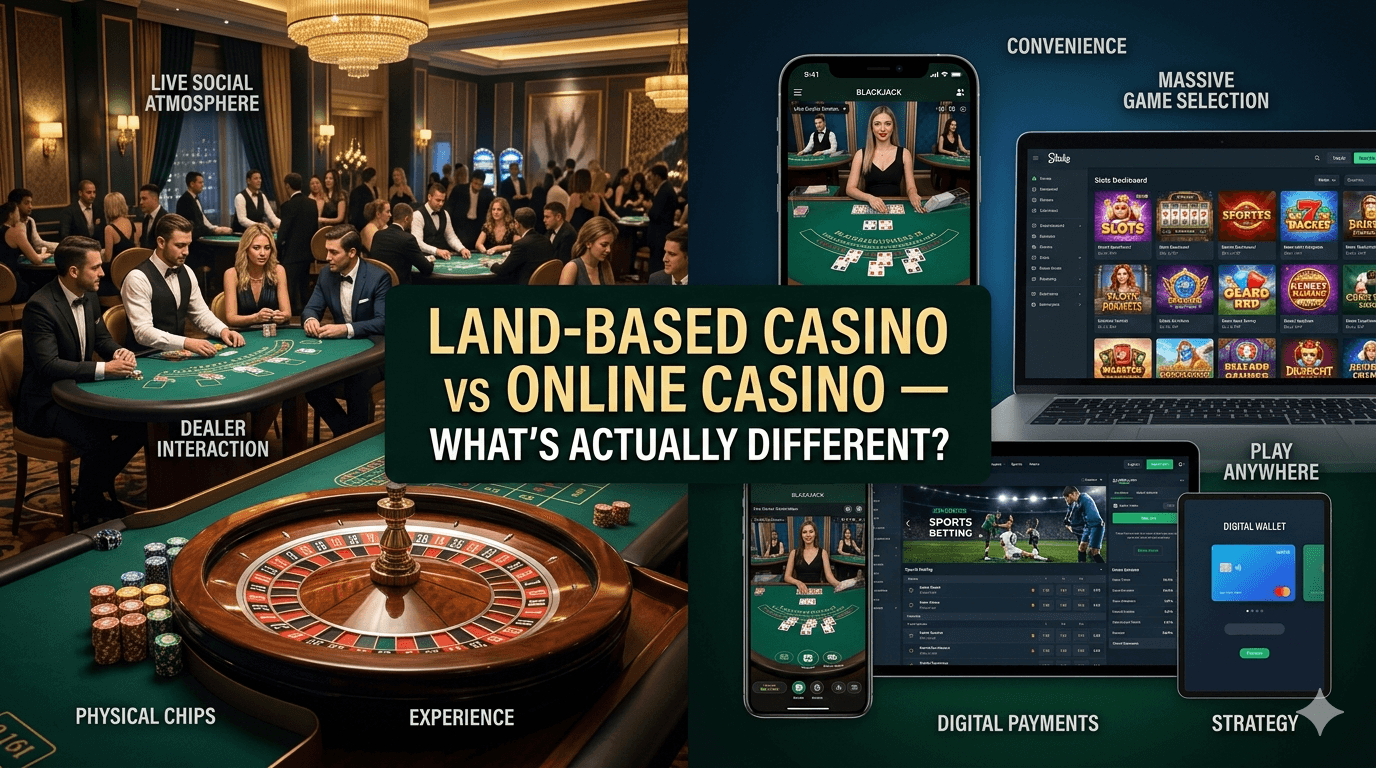
To understand the land-based versus online casino debate, you first need to acknowledge that these two things are not just different delivery mechanisms for the same activity. They are, at their core, different experiences that happen to share a mathematical foundation.
A land-based casino is a total sensory environment. It is deliberately designed — by architects, lighting specialists, sound engineers, and psychologists — to create a specific psychological state: energised, slightly disoriented from time, focused on the present moment. The absence of clocks and natural light on most casino floors is not accidental. The sound of nearby winning machines is not ambient background — it is engineered to create an atmosphere of possibility and excitement. The physical weight of chips in your hand, the tactile ritual of placing a bet on the felt, the eye contact with a dealer — these are all part of a deeply human, embodied experience that has no direct digital equivalent.
An online casino is an on-demand entertainment platform. It gives you complete control — over environment, timing, pace, stakes, and game selection — from any location. It optimises for convenience, choice, and accessibility. It removes every logistical friction point between you and the game. But it also removes everything that isn’t the game itself.
Neither of these is objectively superior. They serve different needs. A player who wants the electric energy of a tournament poker room at the weekend is looking for something a home poker app cannot provide. A player who wants to play 20 hands of blackjack in a 30-minute lunch break cannot do that at a physical casino. The “better” option is always a function of what you’re actually looking for.
That said, let’s compare them across every dimension that matters.
2. Game Selection — It’s Not Even Close
In terms of sheer volume and variety of games available, online casinos win this comparison decisively and without much debate.
Land-based casinos:
Even the largest land-based casinos in the world are limited by physical space. The floor of a casino can hold hundreds of machines and dozens of tables — impressive in person, but finite. A typical large casino might offer:
- 500–2,000 slot machines across a range of themes and denominations
- 20–80 table game positions (blackjack, roulette, baccarat, craps, poker)
- A poker room with 10–30 tables
- A sports betting lounge (in markets where permitted)
The selection available at any given moment is further constrained by how busy the casino is. Peak hour on a weekend night means popular tables are full and you may wait 30–60 minutes for a seat. Minimum bet limits are higher during busy periods, pushing recreational players toward the machines.
Indian casinos — the handful of licensed facilities in Goa, Sikkim, and on cruise ships — are considerably more modest in scale. A floating casino on the Mandovi River might offer 50–100 slot machines and 20–30 table game positions. Choices are genuinely limited compared to what’s available in any mid-tier online casino.
Online casinos:
A mid-sized online casino typically offers:
- 2,000–10,000+ slot titles from dozens of game studios — classic slots, video slots, megaways mechanics, progressive jackpots, licensed branded titles
- Dozens of blackjack variants — different rule sets, deck numbers, side bet configurations, speed variants, and infinite seat availability
- Multiple roulette versions — European, French, American, multi-ball, multi-wheel, immersive, lightning, and more
- Baccarat, craps, poker, pai gow, sic bo, and game show hybrids across multiple variants
- A live dealer section with 50–200+ tables running 24 hours a day
- Sports betting across dozens of sports and thousands of markets simultaneously
The practical implication: at an online casino, you will never wait for a seat, never find your preferred game unavailable, and never be forced to play at a stakes level dictated by a busy floor. If you prefer low-stakes games — ₹10 minimum bets, for example — they are always available online. Many land-based casinos don’t deal at those limits regardless of timing.
Advantage: Online casino, significantly.
3. Payout Percentages — Which Actually Pays More?
This is one of the most practically important differences between the two formats — and online casinos hold a clear, documented advantage.
Why land-based casinos pay less:
Running a physical casino is extraordinarily expensive. Real estate, staffing (dealers, pit bosses, security, hospitality), utilities, maintenance, compliance, marketing — the overhead is enormous. A casino floor that isn’t making substantial margins cannot survive. This cost burden is passed, mathematically, to the player through lower RTPs.
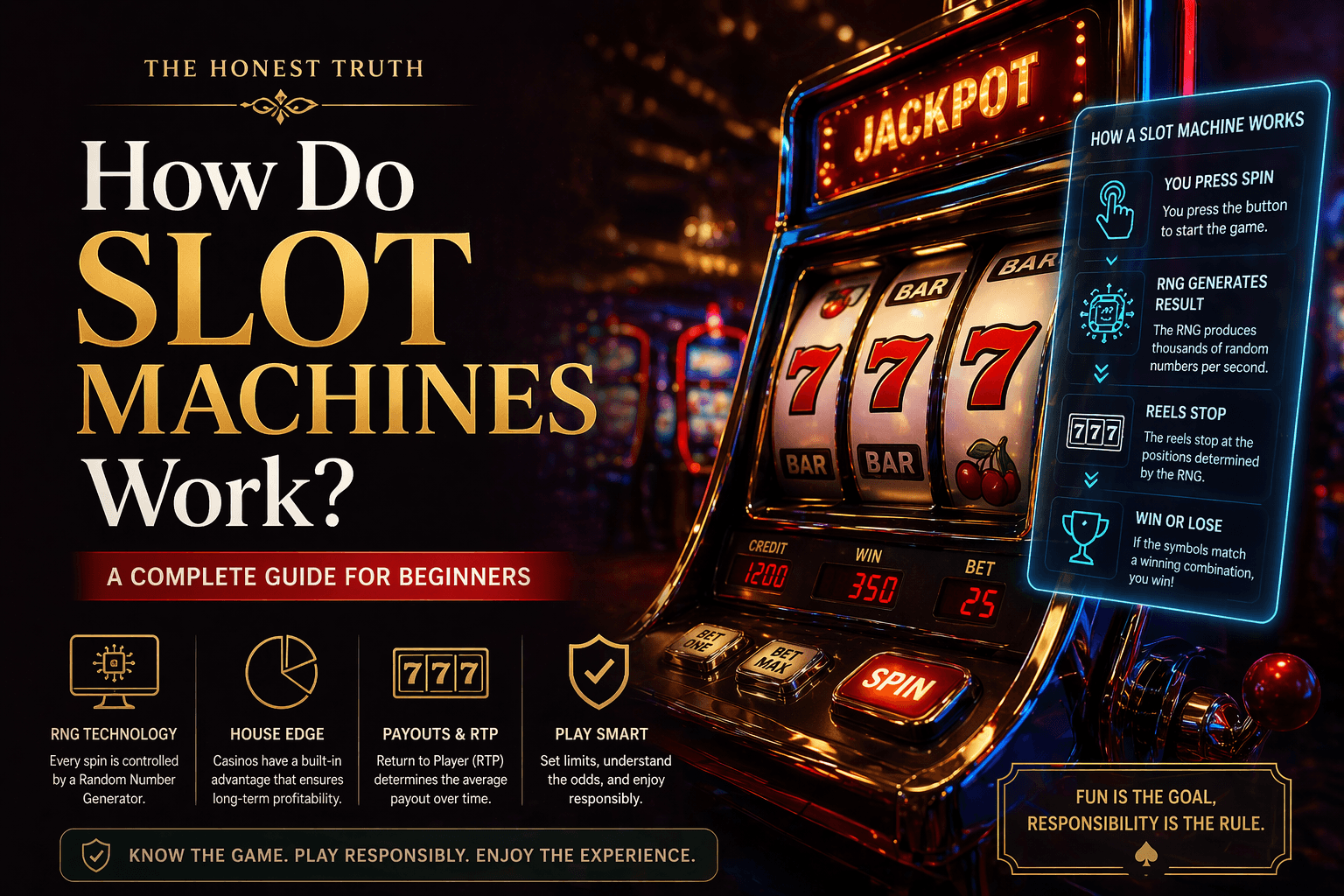
Land-based slot machines in most jurisdictions are set to RTPs of 85–92% — meaning the house edge on an average slot is 8–15%. In some regulated markets (like Nevada, where this data is publicly reported), the average slot machine RTP across the state runs around 93–95% for higher denomination machines and lower for penny slots.
Table game conditions also tend to be less favourable in land-based casinos:
- Blackjack games more frequently use 6–8 deck shoes (increasing the house edge vs fewer decks)
- Fewer land-based casinos offer single-deck blackjack, and when they do, it’s often with rule modifications that disadvantage the player
- Roulette wheels in many physical casinos outside of Europe are American-style double-zero wheels (5.26% house edge) rather than the more favourable European single-zero version (2.70%)
What online casinos offer:
Online slots routinely carry RTPs of 95–97%, with many premium titles reaching 97–99%. The cost of running an online casino — primarily technology infrastructure, licences, and marketing — is significantly lower than maintaining a physical space, and competitive pressure in the online market pushes operators to offer better games to attract and retain players.
Online casino table games are also more frequently offered in their most player-favourable variants:
- European roulette (2.70%) is the standard online; American double-zero versions are offered as a secondary option
- Single-deck blackjack and low-deck games with favourable rules are widely available
- Baccarat with full commission structures and correct payout ratios is universal
In practical terms:
A player making ₹1,00,000 in total bets over a session on an average land-based slot (93% RTP) would expect to retain approximately ₹93,000. The same bets on a comparable online slot at 97% RTP retains ₹97,000 — a ₹4,000 difference on the same betting volume. Across regular play, this difference is substantial.
Advantage: Online casino, clearly.
4. Atmosphere and Social Elements — Where Physical Casinos Win
Every advantage the land-based casino holds in this comparison comes down to atmosphere, and it’s a genuine, significant advantage for the players who value it.
What a physical casino offers that online cannot replicate:
The energy of a casino floor at capacity is something that defies digital reproduction. The ambient noise of hundreds of machines, the focused concentration at blackjack tables, the communal celebration when a craps table goes on a hot streak — there is a social electricity in these moments that is fundamentally embodied. You can feel it physically. It affects your mood, your sense of occasion, and your memory of the experience.
Poker in particular is transformed by physical presence. Reading opponents, maintaining a poker face, picking up on tells, managing table dynamics — live poker is a fundamentally different game from online poker precisely because the human dimension is fully present. Many professional poker players describe the live game as richer, more complex, and more satisfying than online play, even as they acknowledge that online play is more efficient for volume.
The dealer relationship:
In a physical casino, the dealer is a real person with a personality. Regulars develop relationships with favourite dealers. There’s conversation, humour, commiseration. Good dealers make players feel welcome regardless of results. This human element is completely absent from RNG (Random Number Generator) online games.
Live dealer online games partially close this gap — you’re interacting with a real dealer via a camera feed — but the experience remains screen-mediated. The dealer can see a chat box of messages from multiple anonymous players across the world; you are one of many. The intimacy of a one-to-one relationship at a physical table is different in quality.
The social occasion:
For many people, visiting a casino is a social event — an evening out with friends, a special occasion, a holiday activity. The casino is the destination, not just the game. This aspect of gambling as a shared human activity — drinking, dressing up, navigating an unfamiliar space together, celebrating or commiserating together in person — belongs entirely to the physical casino world.
Online’s partial answer:
Live dealer lobbies with chat functionality, online poker rooms with player avatars and emote systems, and multiplayer game show formats like Crazy Time and Monopoly Live have each brought meaningful social elements to online gambling. For players without access to a physical casino — which includes most of India, given the limited number of licensed venues — these are genuine substitutes.
But substitutes they remain.
Advantage: Land-based casino, clearly, for atmosphere and social experience.
5. Convenience and Accessibility
No comparison in this debate is more lopsided than convenience, and this single factor accounts for most of the growth in online gambling globally.
The logistics of a land-based casino visit:
In most of India, visiting a licensed casino means planning an actual trip. The nearest licensed casino for most Indians requires travel to Goa (and then to a specific hotel or cruise ship), Sikkim (a journey involving permits and altitude), or Daman. This is not a casual Tuesday evening decision — it is a holiday, with the associated costs of flights or trains, hotel accommodation, and time off work.
Even for players in cities with accessible casino facilities (a fraction of the global population), a casino visit requires:
- Travel time — commuting to the venue, parking or arranging transport
- Dress code compliance — many casinos have formal or smart-casual requirements
- Operating hours — while many casinos run 24 hours, some have restricted hours and all require physical presence
- Minimum buy-ins — physical casinos typically have higher minimum bets that may not suit casual play
- A full evening commitment — the social and logistical overhead of a casino visit rarely makes sense for a 30-minute play session
Online casino accessibility:
An online casino is available on any internet-connected device, 24 hours a day, 7 days a week, from anywhere with a signal. A session can last 10 minutes or 10 hours. Stakes can start at ₹5 per spin on a slot or ₹10 per hand at a table. No dress code. No travel. No booking. No minimum time commitment. No cover charge.
For the vast majority of the world’s recreational gamblers — people who want to play occasionally, affordably, and without significant logistical overhead — online casinos are the only version that fits their lifestyle. The global growth of online gambling from negligible to a $140+ billion industry in three decades is almost entirely a story of convenience unlocking an audience that the physical casino world could never reach.
For India specifically:
The combination of limited physical casino access, a massive mobile-internet-connected population, and strong gambling instincts around cricket creates an environment where online gambling — whether licensed casino platforms, fantasy sports, or offshore sports betting — is simply the dominant form of gambling participation. The question of land-based versus online is, for most Indians, purely theoretical.
Advantage: Online casino, overwhelmingly.
6. Costs — Drinks, Travel, and Dress Codes vs. Playing From Home
The true cost of a casino visit extends well beyond the money you bring to the tables, and this comparison often surprises people who haven’t examined it carefully.
The full cost of a land-based casino evening:
Consider a typical casino night out — not an extravagant one, just a standard evening:
- Transport: Auto, cab, or fuel — ₹200–₹2,000 depending on distance
- Parking: ₹200–₹500 at many casino hotels
- Dress code: Maintaining appropriate clothing requires occasional investment; casino hotels sometimes have smart-casual to formal requirements
- Food and drinks: Casinos are designed to keep you on the floor. Drinks — even in many jurisdictions where complimentary beverages are offered — involve either cost or obligating continued play. A dinner or late-night snack at a casino restaurant: ₹1,000–₹5,000 per person
- Entertainment add-ons: Shows, live events, hotel stays for destination casinos — these multiply quickly
- Minimum bets: Physical tables typically have minimums of ₹500–₹5,000+ per hand or spin. You cannot play casually at ₹10 stakes at a physical blackjack table
A conservative land-based casino evening — not a holiday, just a local night out — realistically costs ₹3,000–₹8,000 before a single gambling bet is placed.
The cost of an online casino session:
- Hardware: Your existing phone or computer
- Internet: Your existing data plan
- No minimum dress code, no transport, no food minimum
- Stakes starting at ₹5–₹10 on slots and many table games
- No comp obligation — you’re never obligated to keep playing to justify being there
The only direct costs are the gambling bets themselves. This means your gambling budget is entirely your gambling budget — no overhead diluting the recreational value.
The comp system — a partial counterpoint:
Land-based casinos use a loyalty comp system to return some value to regular players — free meals, hotel room upgrades, show tickets, free play credits. High-volume players (“whales”) can receive extraordinary comps that offset substantial costs. For very high-stakes regular players, the comp value at a land-based casino can make it economically competitive with the online experience.
For recreational players betting at moderate stakes, the comps received are unlikely to compensate for the full overhead of the visit.
Online casinos have their own loyalty and VIP systems — cashback, free spins, reload bonuses — which are similarly more valuable to high-volume players.
Advantage: Online casino, substantially, for recreational and low-to-mid stakes players.
7. Which Is Better for Beginners?
This is the most important question for anyone who hasn’t played much before, and the answer requires considering what beginners actually need.
What beginners need most:
A new player entering any gambling environment needs three things: time to learn at their own pace, stakes low enough that mistakes don’t cost a meaningful amount, and information available when they need it without embarrassment.
On all three counts, online casinos serve beginners significantly better.
Free play and demo modes:
Almost every online casino offers a demo mode — the ability to play any game with virtual chips at no cost. A beginner can spend hours learning the rules of blackjack, testing roulette bet types, or understanding how slot bonus features work, without risking a single rupee. This is completely unavailable in land-based casinos, where every seat costs money from the moment you sit down.
Low minimum bets:
Many online casinos offer blackjack tables with ₹10–₹50 minimum bets, slot machines at ₹5 per spin, and roulette with ₹10 minimum stakes. This allows a beginner to develop real experience under real conditions — actual money on the line, real decisions — at a cost that barely registers. Making 20 blackjack decisions for a total stake of ₹200 is a genuine learning session. Making those same 20 decisions at a land-based casino with a ₹1,000 minimum means risking ₹20,000 in a learning session.
No social pressure:
Sitting at a blackjack table in a physical casino as a beginner carries real social pressure. Experienced players can become visibly frustrated at a new player who takes too long to decide, makes unconventional choices, or asks the dealer to explain rules. The pace of a live table is set by the house, not the slowest player. This pressure — even when nothing overt is said — makes learning uncomfortable.
Online, no one is watching. You can take 60 seconds to decide whether to hit a soft 17. You can open a basic strategy chart in another browser tab while you play. No judgement, no pace pressure, no social cost.
Information availability:
Online resources — strategy guides, how-to videos, RTP information, game rules — are a browser tab away while you play. The information density available to an online beginner during play has no physical equivalent.
Where land-based casinos serve beginners well:
Some physical casinos offer free lessons — scheduled sessions where dealers walk new players through table game rules before the casino opens for regular play. These are genuinely valuable for learning the social dynamics and physical mechanics of table games. Some beginners also find that the formality and structure of a physical casino setting helps them take the experience seriously — the money is real, the table is real, the stakes feel tangible in a way that a screen can sometimes mute.
The verdict for beginners:
Start online. Learn the games in demo mode. Play at low stakes with real money to build experience under genuine conditions. Use the strategy resources available to you. Once you’re comfortable with the rules and basic decision-making, a physical casino visit becomes an enhancement of existing knowledge rather than an expensive classroom.
Advantage: Online casino, clearly, for beginners.
The Honest Verdict
This comparison doesn’t produce a single winner because the two formats genuinely excel at different things for different players.
Choose a land-based casino when:
- You want a full night out as a social occasion
- You value the atmosphere and energy of a physical gambling environment
- You play live poker and want the full human dimension of reading opponents
- You’re visiting a gambling destination (Las Vegas, Macau, Goa) and the experience is part of the trip itself
Choose an online casino when:
- You want the best odds and highest RTP games available
- Convenience, accessibility, and flexible timing matter to you
- You’re a beginner who wants to learn without pressure
- You want access to the widest possible game selection
- The nearest physical casino requires significant travel
- You want to play at low stakes without minimum bet constraints
For the vast majority of Indian players — for whom the nearest licensed physical casino involves a significant journey — online gambling is not a compromise version of the real thing. It is simply the version that is actually accessible, and in many measurable ways — payout percentages, game selection, minimum stakes, and accessibility — it is the version with better fundamentals.
The physical casino’s irreplaceable quality is experiential and social. Those are real values. But they are values that come at a cost — financial, logistical, and in terms of the pure mathematical odds on offer.
Know what you’re paying for, and make sure it’s worth it to you.
Disclaimer: This article is for educational and informational purposes only. The legal status of online and land-based gambling varies by state in India. Licensed land-based casinos operate in Goa, Daman, and Sikkim. Please verify the legal status of online gambling in your jurisdiction before participating. If gambling is causing you difficulties, contact iCall on 9152987821.