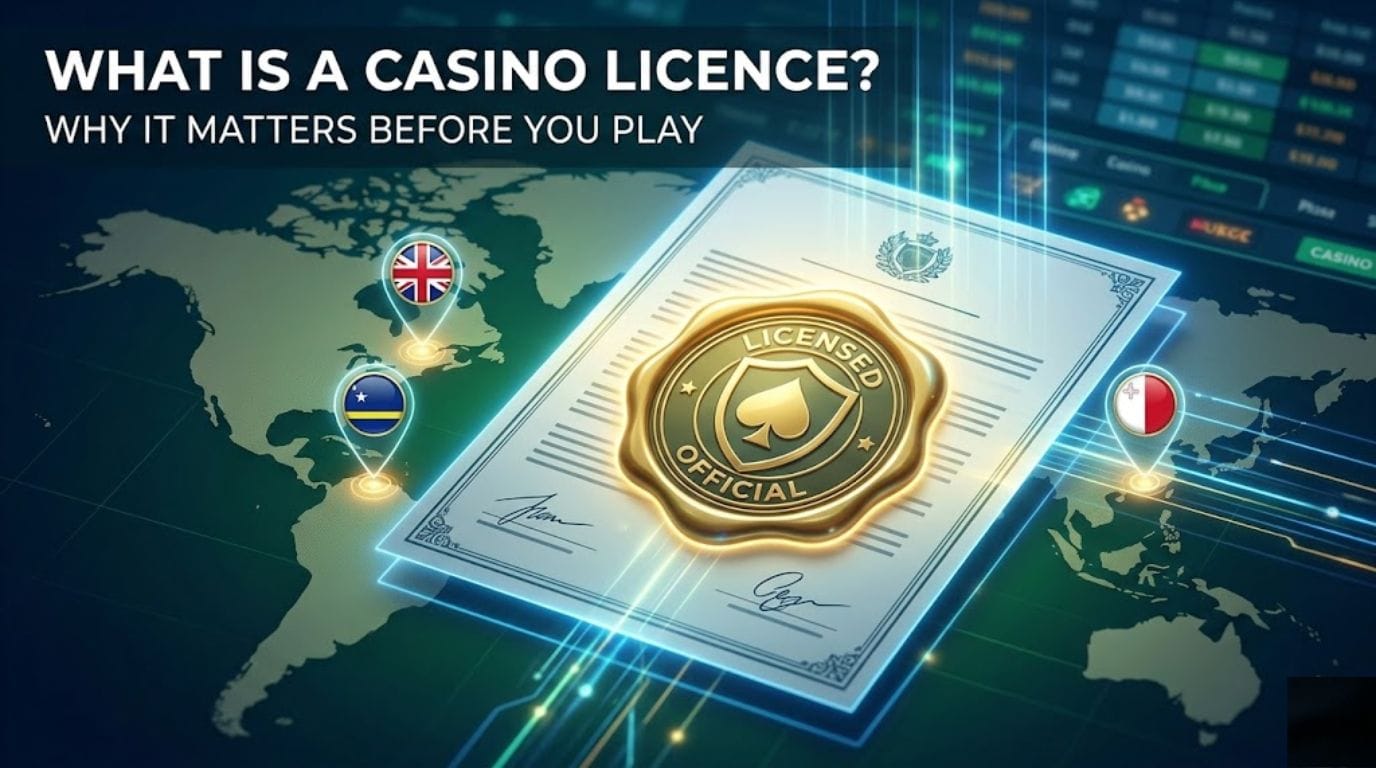
Before you deposit a single rupee at any online casino, there is one question that matters more than the welcome bonus, more than the game selection, and more than the visual design of the website: is this casino licensed?
Licensing is the difference between a regulated business with legal obligations toward you and an anonymous website that can disappear with your money overnight. It is the foundation of consumer protection in an industry where, without it, players have no rights, no recourse, and no safety net.
Yet licensing is also one of the most misunderstood areas of online gambling. Not all licences offer equal protection. Some are rigorous; some are largely nominal. Some jurisdictions have genuine enforcement power; others issue licences primarily for revenue with minimal oversight. Understanding the difference is not a technicality — it is practical, financial self-protection.
Table Of Contents
1. Why Licensing Exists
To understand why casino licensing exists, it helps to understand what the online gambling industry looked like before it did.
In the mid-1990s, when online gambling first emerged, there was essentially no regulatory framework anywhere. Any person or company with technical resources could launch a casino website, accept deposits from players worldwide, and operate entirely without accountability. Games could be rigged. Winnings could be withheld. Deposits could be stolen. Players had no means of verifying that any game outcome was fair, and no legal avenue for complaint if they were defrauded.
Licensing was developed to solve this problem — to create a formal relationship between governments, operators, and players that established minimum standards, accountability, and enforcement mechanisms.
What a gambling licence is, precisely:
A gambling licence is a formal authorisation issued by a government regulatory body — called a gambling commission, gaming authority, or gaming board — that permits a specific operator to offer gambling services. The licence is conditional on the operator meeting and maintaining a set of standards across several areas:
Financial integrity: The operator must demonstrate it has sufficient capitalisation to pay out player winnings, must hold player funds in segregated accounts (separate from operational funds), and must undergo regular financial audits. This prevents the scenario where a casino pays bonuses it cannot cover or uses player deposits to fund operations.
Game fairness: Licensed operators must use certified Random Number Generators (RNG) for their games, with certification provided by independent testing laboratories (eCOGRA, iTech Labs, BMM Testlabs, NMi). The published RTP figures for each game must be accurate and verifiable. Regular audits ensure that outcomes over time match the stated mathematics.
Player protection: Operators must implement responsible gambling tools — deposit limits, self-exclusion options, reality check notifications — and must not market to vulnerable individuals, minors, or people who have self-excluded. Age verification (KYC) is mandatory before real-money play.
Anti-money laundering (AML): Casinos are legally required to monitor transactions for suspicious activity, verify the source of large deposits, and report suspicious activity to relevant authorities. This prevents the industry from being used as a conduit for laundering criminal proceeds.
Complaint resolution: Licensed operators must participate in formal dispute resolution processes. If a player has a valid complaint against a licensed casino that the operator refuses to resolve, the player can escalate to the licensing authority or an approved Alternative Dispute Resolution (ADR) service.
The regulator’s role:
The licensing authority does not simply issue a licence and forget about it. In well-regulated markets, regulators actively monitor operators — reviewing financial reports, investigating player complaints, conducting unannounced audits, and applying sanctions (fines, licence suspension, licence revocation) when operators fall short of their obligations. The strength of a licence is directly proportional to the rigour of this ongoing oversight.
2. The World’s Major Gambling Jurisdictions
Not all gambling licences are equivalent. Here is a guide to the major licensing bodies — from the most rigorous to the most permissive — and what each means in practice.
UK Gambling Commission (UKGC)
Jurisdiction: United Kingdom Licence type: High regulatory standard Website: gamblingcommission.gov.uk
The UKGC is widely considered the gold standard of gambling regulation globally. Established by the Gambling Act 2005, it regulates all commercial gambling in Great Britain — online and offline. Any operator serving UK players must hold a UKGC licence, regardless of where the company is based.
What UKGC licensing means for players:
- Mandatory segregation of player funds from operational funds — your balance is protected even if the operator becomes insolvent
- Mandatory participation in GAMSTOP — the national self-exclusion scheme that works across all licensed operators
- Strict advertising standards — gambling ads cannot target under-25s, use celebrities popular with younger audiences, or imply gambling leads to financial success
- Active complaint escalation pathway — unresolved complaints can be escalated to an ADR service approved by the UKGC
- Regular publication of enforcement actions — fines and sanctions against licensed operators are public record
The UKGC issues substantial fines for regulatory breaches — including multi-million pound penalties for major operators who have failed AML obligations or social responsibility requirements. The regulatory teeth are real.
Malta Gaming Authority (MGA)
Jurisdiction: Malta (European Union) Licence type: High regulatory standard Website: mga.org.mt
The MGA is the primary licence for online gambling operators targeting European markets outside the UK. Malta’s status as an EU member state gives its regulatory framework European legal weight. The MGA has operated since 2001 and has progressively tightened its standards to near-UKGC levels.
What MGA licensing means for players:
- Rigorous financial checks before a licence is issued and on an ongoing basis
- Player Fund Protection requirements — though the exact level of protection varies by the operator’s chosen fund protection class
- A formal Player Support Unit that investigates complaints against licensed operators
- Certified game fairness from approved testing laboratories
- AML compliance requirements aligned with EU anti-money laundering directives
The MGA is a legitimate, well-enforced licence. It is sometimes considered marginally below UKGC in the strictness of its responsible gambling requirements, but it remains one of the two or three most respected licences in the industry.
Gibraltar Regulatory Authority (GRA)
Jurisdiction: Gibraltar (British Overseas Territory) Licence type: High regulatory standard Website: gra.gi
Gibraltar has been a significant gambling jurisdiction since the early 2000s and hosts the European headquarters of several major betting and casino operators. Its small size and close regulatory relationship with the UK (Gibraltar implements equivalent standards to many UK regulations) make it a respected licence.
What GRA licensing means for players:
- Similar player protection standards to MGA
- Strong financial solvency requirements
- The small number of licensed operators (relative to MGA or UKGC) means more individuated regulatory attention per licensee
- Operators must maintain a physical presence in Gibraltar
The GRA is particularly associated with sports betting operators but also covers online casinos.
Swedish Gambling Authority (Spelinspektionen)
Jurisdiction: Sweden Licence type: High regulatory standard Website: spelinspektionen.se
Sweden re-regulated its gambling market in 2019, replacing state monopolies with a competitive licensed market. The Spelinspektionen operates SPELPAUS — Sweden’s national self-exclusion register — and maintains strict standards on advertising, bonuses (deposit bonuses are restricted), and responsible gambling tools.
Kahnawake Gaming Commission (KGC)
Jurisdiction: Kahnawake Mohawk Territory, Canada Licence type: Moderate regulatory standard Website: kahnawake.com/gamingcommission
One of the earliest licensing bodies in the world — established in 1999 to regulate gambling businesses operating from Kahnawake territory in Quebec, Canada. The KGC has been a legitimate and functional regulator for over two decades, with a formal complaint resolution process and established operating standards.
What KGC licensing means for players:
- Formal complaint submission pathway
- Game certification requirements
- Financial integrity checks
- Reasonably established enforcement history
The KGC is a genuine licence with real (if limited) enforcement capability. It is not at the level of UKGC or MGA in terms of the comprehensiveness of player protection, but it is considerably more meaningful than a Curaçao licence.
Curaçao eGaming (Antillephone N.V.)
Jurisdiction: Curaçao, Kingdom of the Netherlands Licence type: Low-to-moderate regulatory standard Website: curacao-egaming.com
Curaçao is the most commonly issued gambling licence in the world — and the most misunderstood. It exists on a spectrum between a legitimate (if minimal) regulatory framework and a near-rubber-stamp that confers the appearance of legitimacy more than its substance.
The Curaçao master licence model has historically worked by issuing four master licences to local operators, who then sub-licence to hundreds of online casinos. The sub-licensed operators are not directly scrutinised by the government — they are overseen by the master licence holder. This creates a highly attenuated regulatory chain.
What Curaçao licensing means for players:
- Operator is legally required to exist as an entity (not a complete phantom operation)
- Some complaint resolution pathway exists through the master licence holder
- Game fairness certification is not always mandatory
- Player fund protection requirements are minimal compared to MGA or UKGC
- Financial solvency audits are far less rigorous than in premium jurisdictions
- The licence does not require the operator to implement national self-exclusion or comprehensive responsible gambling tools
The nuanced reality:
Many legitimate, long-running, reputable online casinos operate on Curaçao licences — particularly those serving markets (including India) where no local licensing framework exists. The licence itself does not make a casino a scam. But it does mean the consumer protection framework is considerably thinner than with premium licences. A Curaçao licence is a necessary minimum bar, not a sufficient guarantee of safety.
The reform situation:
Curaçao announced significant reforms to its licensing framework in 2023, moving toward a more direct regulatory model and higher standards for licensed operators. The new framework is in the process of implementation, and its practical effect remains to be seen.
3. What Each Licence Actually Means for Players
Translating jurisdiction differences into practical player experience:
UKGC or MGA — Strong Protection:
- Your funds are ring-fenced. Even if the casino becomes insolvent, your balance is protected under regulatory requirements.
- If the casino refuses to pay a legitimate withdrawal, you have a formal, functional complaints escalation pathway — first to the casino’s ADR service, then to the regulator itself.
- Games are independently certified and audited. Stated RTPs are real.
- Responsible gambling tools (deposit limits, self-exclusion, reality checks) are mandatory and must function as described.
- You are protected from predatory marketing — the casino cannot send promotional material to self-excluded players or use advertising that targets vulnerable individuals.
Curaçao — Minimal Protection:
- No mandatory fund segregation — in theory, player deposits and operational funds can be commingled, creating insolvency risk.
- Complaint resolution pathway exists on paper but is less reliable in practice.
- No mandatory link to national self-exclusion schemes.
- Game fairness is certified by some but not all Curaçao-licensed operators.
No Licence — No Protection:
- No legal obligations toward players whatsoever.
- Winnings can be withheld with no formal recourse.
- Game outcomes can be manipulated without independent verification.
- Deposits can be taken and the site can disappear.
4. How to Verify If a Casino Is Licensed — Step by Step
Checking a casino’s licence takes under five minutes and is one of the most important things you can do before depositing. Here is the complete process:
Step 1: Find the licence information on the casino website
Every legitimate licensed casino displays its licensing information in the footer of its website. Look for:
- The name of the licensing authority
- The licence number
- Often a clickable logo that links to the regulator’s website
If you cannot find any licensing information — or if the footer mentions only vague phrases like “licensed and regulated” without naming a specific authority and licence number — treat this as a significant red flag.
Step 2: Go directly to the regulator’s website
Do not trust the licence number displayed on the casino website alone. Open a new browser tab and go directly to the regulator’s official website:
- UKGC: gamblingcommission.gov.uk/check-if-an-operator-is-licensed
- MGA: authorisation.mga.org.mt/verification
- GRA: gra.gi/licensing
- Curaçao: curacao-egaming.com (licensed operators list)
- KGC: kahnawake.com/gamingcommission (certified operators list)
Use the official regulator’s own database to verify that the licence number matches the casino name and that the licence is currently active (not expired, suspended, or revoked).
Step 3: Check the licence status
An active licence in good standing should show:
- The operator name as it appears on the casino website
- Licence number matching what the casino displays
- Status: Active / Valid (not Suspended, Revoked, or Expired)
- The permitted activities covered by the licence (casino, sports betting, poker, etc.)
Step 4: Cross-reference with community reputation
Beyond the licence, check what players are saying about the casino’s actual behaviour:
- AskGamblers (askgamblers.com): Aggregates player reviews and lists casinos with documented unresolved complaints
- Casino Guru (casino.guru): Maintains a “black list” of casinos with documented safety issues
- Trustpilot: General user reviews, useful for pattern recognition
- Reddit (r/onlinegambling, r/casinobonuses): Community discussions often surface issues with specific casinos months before formal actions
Step 5: Review Terms and Conditions
Before depositing, read:
- The bonus terms — particularly wagering requirements and withdrawal restrictions
- The withdrawal process — pending periods, verification requirements, limits
- The account closure and fund return policy — what happens to your balance if you choose to close your account
A legitimate, well-licensed casino has clear, accessible, readable terms. Vague, contradictory, or extremely restrictive terms are a warning signal regardless of licensing status.
5. What Happens When Unlicensed Casinos Scam Players
Understanding the consequences of playing at an unlicensed site is essential — because the consequences are severe and the remedies are essentially non-existent.
The most common scam patterns:
Withdrawal refusal: The most frequent complaint against unlicensed casinos. A player wins a significant amount, requests a withdrawal, and the casino either ignores the request, invents a pretextual reason to deny it (claiming a bonus term violation or KYC issue that doesn’t exist or was manufactured), or simply stops responding. Without a regulatory complaint pathway, the player has no mechanism to compel payment.
Account closure without fund return: The casino closes a player’s account and declines to return the remaining balance. Common pretexts include alleged “terms violations” or “multiple accounts.” In a licensed casino, these allegations can be challenged through the ADR process and regulator. At an unlicensed casino, the operator’s decision is final.
Exit scams: The casino processes deposits normally for a period, building a player base and accruing deposits, then disappears entirely. The website goes offline. The support email bounces. The payment method accounts are closed. Player funds are gone with no recovery mechanism.
Rigged games: Without independent certification and auditing requirements, an unlicensed casino can run games with RTPs far below advertised figures or with outcomes that are not genuinely random. A slot claiming 96% RTP might be running at 60% or be programmed to prevent wins above a certain amount. Players have no way to verify this from the outside.
What recourse do scammed players actually have?
The honest answer is: very little.
- Chargeback claims: If you deposited via credit card, a chargeback claim to your card provider is sometimes successful — particularly if the transaction is recent and the fraud is demonstrable. Most casinos now use payment processors specifically chosen to resist chargebacks. Cryptocurrency deposits are irreversible — no chargeback possible.
- Legal action: Theoretically possible but practically impractical. Unlicensed casinos operate behind anonymous company structures in non-cooperative jurisdictions. Litigation costs exceed the typical disputed amount by many multiples.
- Regulatory complaints: Cannot be filed against an unlicensed operator — there is no regulator with jurisdiction.
- Community warnings: Posting about the experience on forums and review sites warns other players but recovers nothing.
The practical reality is that money lost to an unlicensed casino is almost always gone. Prevention — verifying licensing before depositing — is the only meaningful protection.
6. Red Flags of Unlicensed Operations
Recognising the warning signs of an unlicensed or untrustworthy casino before depositing requires knowing what to look for. Here are the most reliable indicators:
No licence information in the footer A legitimate licensed casino always displays its licensing information prominently in the site footer — typically including the licensing authority’s logo (clickable), the licence number, and a brief description of the regulated activities. A footer that shows only a company name and registered address with no licensing data is a serious red flag.
Licence information that cannot be verified The casino claims to be licensed but the licence number doesn’t appear in the regulator’s public database, or the licensed entity name doesn’t match the casino’s operating name. Common in casinos that display a real licence number belonging to a different operator.
No independent game certification Legitimate games display certification logos from approved testing labs (eCOGRA, iTech Labs, BMM). If no such certification is visible anywhere on the site, or if the casino cannot provide RTP data for its games, it is not subject to any meaningful fairness oversight.
Withdrawal problems documented in player communities Before depositing at any casino, a 10-minute search on AskGamblers or Casino Guru for “[Casino Name] withdrawal problems” is one of the most valuable due diligence steps available. A pattern of documented withdrawal refusals — especially with similar pretextual justifications — is a strong indicator of a problem operator.
Aggressive bonus terms with no clear withdrawal conditions Bonuses with absurdly high wagering requirements (60x, 80x, 100x), game restrictions that limit wagering to the highest house edge games, or terms that give the casino discretion to void winnings under vague conditions are indicators of a casino that uses bonuses as a mechanism to take deposits without genuine intent to pay out.
No clear responsible gambling policy or tools Any regulated casino is required to have and display responsible gambling information and tools. A casino with no information about deposit limits, self-exclusion, or problem gambling resources is either unregulated or actively non-compliant with its regulatory obligations.
Opaque ownership and corporate structure Legitimate online casinos are operated by identifiable companies with verifiable corporate registrations. If research into the operator behind a casino leads to anonymous shell companies, untraceable ownership structures, or a blank wall — treat this as a serious concern. The best casinos make their operator entity and corporate information clearly accessible.
Customer support that evades direct questions Test a casino’s customer support before depositing — specifically ask: “What is your licence number and which authority issued it?” A legitimate casino’s support agent answers this immediately. Evasive responses, redirects to the terms page, or failure to provide a specific licence number suggest the casino cannot answer the question truthfully.
Unsolicited contact and aggressive re-engagement Casinos that contact you via WhatsApp, Telegram, or SMS with unsolicited offers claiming you’ve won prizes or have unclaimed bonuses — particularly ones that request deposits to “release” winnings — are running scams. No licensed, reputable casino operates this way.
The Licensing Check — A Non-Negotiable Step
The online gambling industry contains thousands of platforms — ranging from the world’s most rigorously regulated operators to outright criminal enterprises. The licence is the single most reliable filter available to you as a player, and checking it takes less time than reading the bonus terms.
A simple process to follow before depositing anywhere:
- Find the licence information in the footer
- Open the regulator’s website directly (not via a link from the casino)
- Search the regulator’s database for the casino’s licence number
- Confirm: Active status. Correct operator name. Licence covers casino operations.
- Cross-check community forums for withdrawal complaint patterns
Five minutes of verification can protect you from losing your entire deposit to a fraudulent operation with no means of recovery. No bonus offer, however attractive, is worth skipping this step.
For Indian players specifically — where the domestic regulatory framework for online casinos is still developing and most casino play happens on international platforms — this verification is even more critical. The Indian legal system has no enforcement jurisdiction over an offshore unlicensed casino that steals your deposits. The only protection available is choosing your platform carefully before the money leaves your account.
The licence is not a guarantee. But its absence is as close to a guarantee of risk as the gambling world offers.
Disclaimer: This article is for educational and informational purposes only. The legal status of online gambling varies by state in India. Please verify the regulations applicable to your jurisdiction before participating in online gambling. If you have been the victim of a gambling scam, contact your bank or payment provider as a first step. If gambling is causing difficulties, contact iCall on 9152987821.