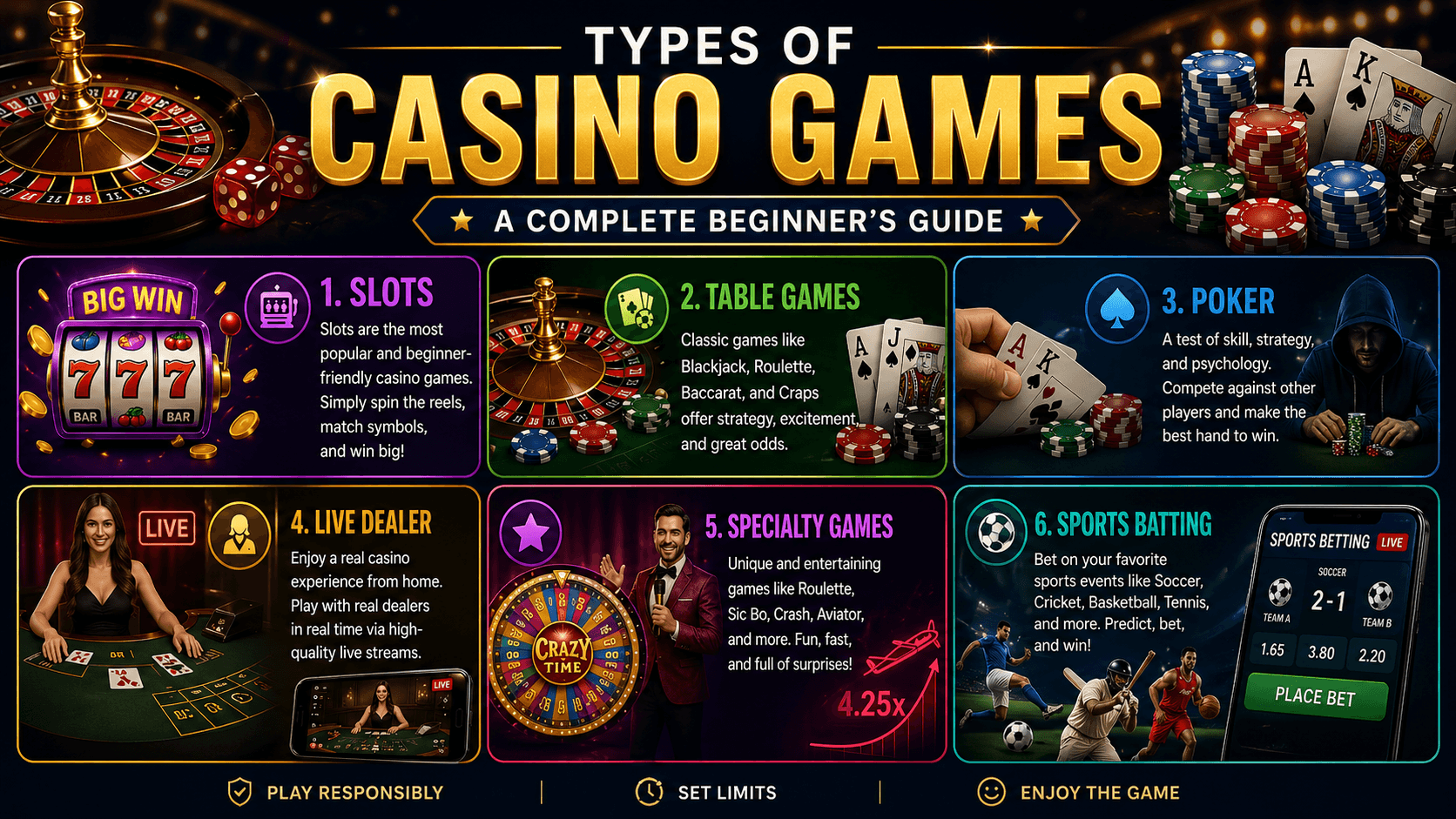
Step into any online casino for the first time and the sheer volume of choice can be overwhelming. Hundreds of slot titles. Multiple roulette variants. Poker rooms. Live tables. Sports betting. Bingo halls. Scratch cards. The lobby looks like a digital theme park with no map.
The good news is that almost every casino game ever invented falls into one of six or seven distinct categories — and once you understand what each category offers, how it works, and what kind of player it suits, the whole landscape suddenly makes sense. This guide is that map.
Whether you’ve never placed a bet in your life or you’ve been playing casually for years without really understanding the mechanics, this complete guide to casino game types will help you find your footing and, more importantly, find the games that are right for you.
Table Of Contents
1. Introduction — Not All Casino Games Are Equal
Here is the single most important thing a beginner can understand about casino games: they are not all equal.
They differ in house edge — the mathematical advantage the casino holds. They differ in the role of skill versus chance. They differ in pace, in social experience, in minimum stakes, in potential rewards, and in the cognitive effort they demand.
A game of blackjack, played with basic strategy, can have a house edge as low as 0.5% — meaning the casino only keeps 50 paise for every ₹100 wagered over time. A poorly chosen slot machine, by contrast, might carry a house edge of 10–15%. Understanding these differences isn’t just academic — it directly affects how long your money lasts and what kind of experience you have.
Games also sit on a spectrum from pure chance (lottery, slots, roulette) to pure skill (professional poker). Most casino games live somewhere in between — chance-driven but with decisions that improve or worsen your odds. Knowing where a game sits on that spectrum helps you match it to your goals and your personality.
Let’s go through each category in depth.
2. Table Games — The Heart of the Casino Floor
Table games are the oldest form of organised casino gambling and still carry the most prestige. They’re played on a felt-covered table, with a live dealer (in physical casinos) or a digital equivalent (online), and they offer some of the best odds available to any casino player.
Blackjack
Blackjack is the most strategically rich of all table games and the one where player decisions matter most. The objective is simple: get a hand closer to 21 than the dealer without going over. You start with two cards, and you choose to hit (take another card), stand (keep your total), double down, split pairs, or in some variants, surrender.
What makes blackjack exceptional for players is that a well-studied strategy chart — called basic strategy — tells you the mathematically optimal decision for every possible hand against every possible dealer upcard. Follow basic strategy consistently and the house edge drops to approximately 0.5%, making blackjack one of the most player-friendly games in the casino.
Blackjack rewards patience, discipline, and a willingness to learn. It is the ideal gateway game for beginners who want to feel in control of their outcomes.
House edge: 0.5%–2% (depends on variant and strategy used) Skill factor: High Best for: Players who enjoy strategic thinking and want the best possible odds
Roulette
Roulette is perhaps the most iconic casino game in the world — the spinning wheel, the bouncing ball, the breathless pause before it settles. It requires no skill, no strategy, and no experience. You place chips on a number, a colour, a group of numbers, or a range (odd/even, high/low), and you wait.
There are two main variants every beginner should know about:
- European Roulette — 37 pockets (0–36), a house edge of 2.7%
- American Roulette — 38 pockets (0–36, plus 00), a house edge of 5.26%
This difference is significant. The extra double-zero pocket in American roulette nearly doubles the casino’s advantage. Unless you specifically prefer the American version, always choose European roulette. Some casinos also offer French Roulette, which includes the La Partage rule — if the ball lands on 0, you get half your even-money bet back — reducing the house edge to just 1.35% on those bets.
Roulette is the perfect choice for social, casual players who want simplicity and the possibility of exciting big wins from straight-up number bets (which pay 35:1).
House edge: 1.35%–5.26% (depends on variant) Skill factor: None — pure chance Best for: Beginners, casual players, those who prefer a relaxed social pace
Baccarat
Baccarat has a reputation for being a game of the wealthy elite — James Bond played it in the early films, and high-roller rooms in Macau are built around it. In reality, it is one of the simplest games at any casino, requiring zero skill and very few decisions.
You bet on one of three outcomes: the Player hand wins, the Banker hand wins, or it’s a Tie. Cards are dealt according to fixed rules — you don’t choose to hit or stand. The hand closest to 9 wins. That’s essentially it.
What makes baccarat remarkable is that the Banker bet carries a house edge of just 1.06% — one of the lowest in the entire casino. The Player bet is 1.24%. The Tie bet, despite its attractive 8:1 payout, carries a devastating house edge of around 14% and should be avoided.
Baccarat is enormously popular among Indian and Asian players more broadly, partly for cultural reasons and partly because the low house edge and simple mechanics make it a rational choice for high-stakes play.
House edge: 1.06% (Banker) / 1.24% (Player) Skill factor: None — fixed rules determine all card decisions Best for: Players who want excellent odds without needing to learn complex strategy
Craps
Craps is the loudest, most energetic, and most socially charged game on any casino floor. It’s played with two dice, and players bet on the outcome of dice rolls in a series of sequential phases. The energy around a hot craps table is unlike anything else in a casino.
Craps looks intimidating because the betting layout is covered in dozens of betting options with exotic names — Pass Line, Don’t Pass, Come, Don’t Come, Place bets, Proposition bets. But here’s the key insight: the vast majority of these bets are poor value. You only need to know a handful.
The Pass Line bet — the most fundamental bet in the game — carries a house edge of just 1.41%. Adding Free Odds behind a Pass Line bet (a bet with literally zero house edge, one of the only such bets in any casino) reduces the combined house edge further. Stick to Pass/Don’t Pass and Come/Don’t Come with full odds, and craps becomes one of the best-value games in the building.
House edge: As low as 1.41% (Pass Line); much higher on proposition bets Skill factor: Low — but choosing the right bets matters enormously Best for: Players who enjoy high energy, social games and are willing to learn the layout
3. Card Games — Poker and Its Variants
Poker occupies a unique position in the gambling world because it is the one major casino game where you are competing against other players, not against the house. The casino makes its money by taking a rake (a percentage of each pot) rather than by holding a mathematical edge over each hand.
This means that a skilled poker player can achieve a positive expected value — they can be a long-term winner. No other commonly played casino game offers this.
Texas Hold’em
The world’s most popular poker variant. Each player receives two private cards (hole cards). Five community cards are dealt face-up in stages — the Flop (three cards), the Turn (one card), and the River (one card). Players combine their hole cards with community cards to make the best five-card hand.
The betting structure — with rounds of betting after each deal stage — is what makes Texas Hold’em so strategically deep. Position, pot odds, reading opponents, bluffing, and hand selection all matter. It takes minutes to learn and years to master.
Omaha
Similar to Hold’em, but each player receives four hole cards and must use exactly two of them (combined with exactly three community cards) to make their hand. This creates bigger hands and bigger pots, making Omaha particularly popular among action-oriented players.
Three-Card Poker
A faster, simpler poker variant designed specifically for casino play — you’re against the dealer, not other players. You receive three cards, the dealer receives three cards, and the better hand wins. A popular choice for beginners who want the flavour of poker without the complexity of player-versus-player dynamics.
Casino Hold’em
Another dealer-versus-player variant where you play a simplified form of Texas Hold’em against the house. Lower skill ceiling than the full game but a good entry point.
House edge (vs dealer games): 2–3.5% depending on variant Skill factor (Texas Hold’em): Very high — skill is the primary determinant of long-term results Best for: Players who want the deepest strategic challenge and the possibility of being long-term winners
4. Slot Machines — Classic, Video, and Progressive
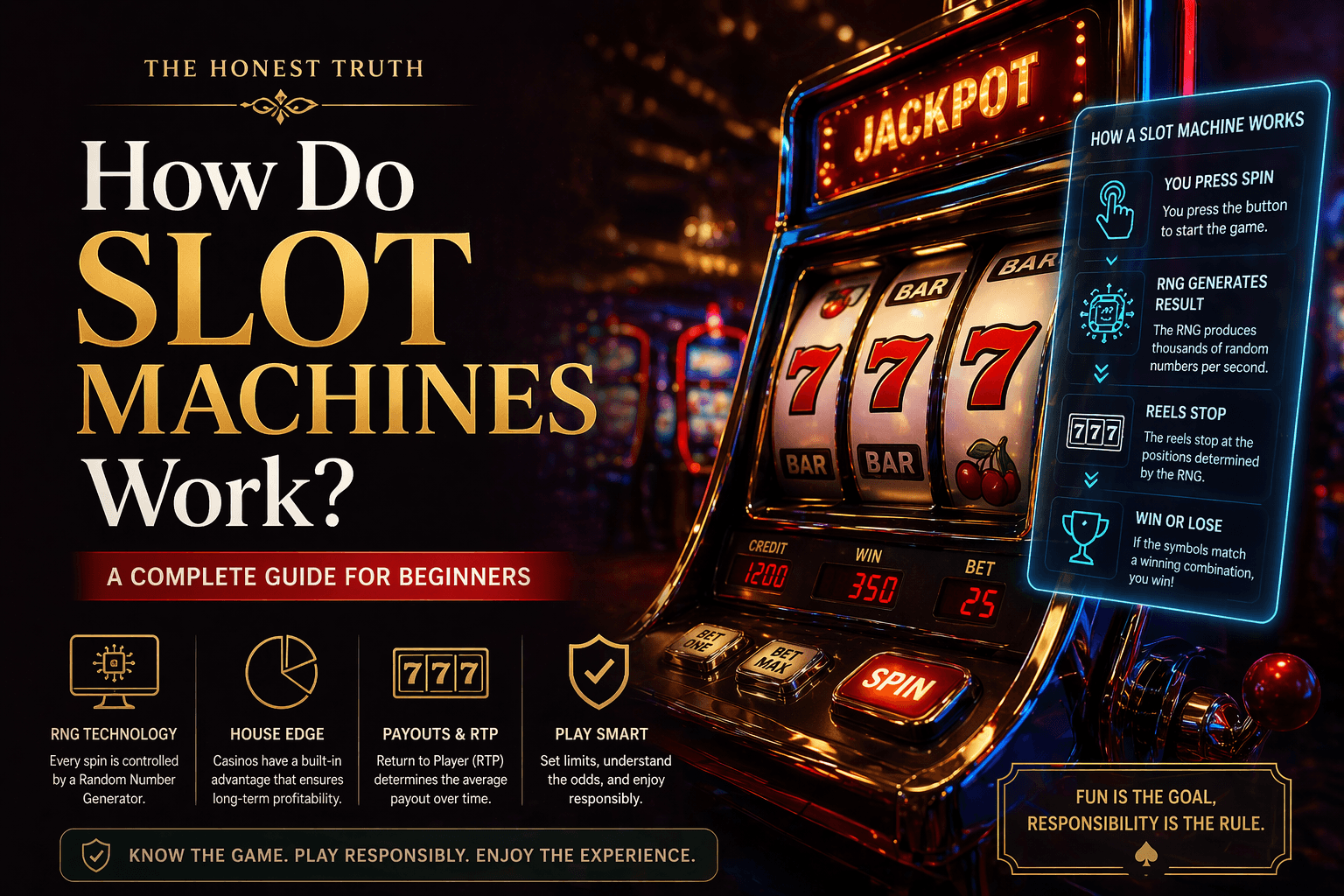
Slots are the most popular category of casino game by player count and by revenue generated — in most online casinos, they account for 70–80% of total game volume. They are also, it must be said, the category with the highest house edge and the least player influence over outcomes.
The appeal is easy to understand: they require no skill, no prior knowledge, no strategy. You pick a game that looks or sounds appealing, set your stake, and spin. The visuals, animations, sound design, and bonus features are engineered to be engaging and entertaining.
Classic Slots (3-Reel)
The original slot machine format — three reels, a limited number of paylines (often just one or three), and straightforward symbols like fruit, bells, and bars. Minimal bonus features. Lower variance, simpler experience. Good for beginners who want to understand the basics before moving to more complex titles.
Video Slots (5-Reel)
The modern standard. Five reels, multiple paylines (often 20–50 or more, sometimes hundreds via “ways to win” mechanics), rich graphics, themed content, and elaborate bonus features — free spins rounds, multipliers, cascading reels, pick-me games, and more. The variety is extraordinary; themes range from ancient mythology to Bollywood to space exploration.
Progressive Jackpot Slots
A category where a small percentage of every bet placed — by any player, on any connected machine — feeds into a central jackpot that grows continuously until someone wins it. Progressive jackpots can reach life-changing sums — tens of millions of rupees, sometimes more on globally linked networks.
The trade-off is that progressive jackpot games have a lower baseline RTP (return to player) than standard slots, because part of each bet is feeding the jackpot pool. You’re essentially buying a lottery ticket with better entertainment value.
House edge: 2%–15% depending on the game (always check the RTP) Skill factor: None — outcomes determined entirely by RNG Best for: Casual players seeking entertainment; jackpot hunters willing to accept lower average returns for life-changing potential
5. Live Dealer Games — The Best of Both Worlds
Live dealer games are one of the most significant innovations in online gambling history, and they deserve their own category.
The concept is straightforward: instead of a computer-generated outcome, you watch a real human dealer — streamed in high definition from a purpose-built studio — deal real cards, spin a real roulette wheel, or run a real game show. You interact via a chat interface. The results are genuine, not algorithmically generated.
Companies like Evolution Gaming, Playtech, and Pragmatic Play Live have built elaborate studio environments — multiple camera angles, professional dealers, slick graphical overlays — that create an experience that is genuinely more immersive than standard online casino games and more convenient than travelling to a physical casino.
Live dealer lobbies typically offer:
- Live Blackjack — Multiple tables at different stakes
- Live Roulette — Including Lightning Roulette (with random multipliers), Immersive Roulette
- Live Baccarat — Particularly popular with Indian and Asian players
- Live Game Shows — Crazy Time, Monopoly Live, Deal or No Deal — hybrid games with a game-show format and large multiplier prizes
The house edges in live dealer games are identical to their standard table game equivalents — live blackjack still has 0.5% with basic strategy; live European roulette still has 2.7%. The only difference is the experience.
Best for: Players who find standard online games too sterile and want the social atmosphere of a real casino without leaving home
6. Specialty Games — Keno, Bingo, and Scratch Cards
Specialty games are the casual fringe of the casino — simpler, faster, and generally carrying higher house edges than table games. They appeal to players who prioritise entertainment and simplicity over strategic depth or optimal odds.
Keno
Keno is essentially a lottery played in real time. You select numbers from a grid (typically 1–80), and the casino draws 20 random numbers. The more of your selections that match, the more you win. Draws happen every few minutes. House edges are typically high — 20–35% — making keno one of the worst-value games in the casino from a purely mathematical perspective. That said, the low stakes and simple mechanics make it accessible.
Bingo
The same bingo you might have played at a school fair — numbers called at random, players marking off cards, the first to complete a pattern wins. Online bingo has evolved significantly, with social features (chat rooms, community jackpots) making it as much about connection as competition. House edges vary widely by platform and game type.
Scratch Cards (Instant Win)
Digital versions of the physical scratch cards available at shops. You pay a fixed amount, “scratch” virtual panels to reveal symbols, and either win or don’t. Simple, fast, and no-frills. Can offer good value when RTP percentages are published (some reach 95%+), but the lack of strategy or engagement makes them a diversion rather than a destination.
Best for: Players who want zero complexity, short sessions, or a casual break between other games
7. Sports Betting — A Different Kind of Gambling
Sports betting technically sits outside the “casino games” category but is offered on most major gambling platforms and deserves inclusion in any complete overview.
Unlike casino games — where you play against a fixed mathematical house edge — sports betting involves assessing probability and comparing it against the odds offered by a bookmaker. When you believe the true probability of an outcome is higher than the bookmaker’s odds imply, you have a value bet.
This makes sports betting uniquely skill-dependent among gambling activities. Professional sports bettors — called “sharps” — make consistent long-term profits by identifying and exploiting pricing errors in betting markets. The vast majority of recreational bettors, however, lose money over time due to the bookmaker’s built-in margin (the “juice” or “vig”).
In India, cricket betting dominates the sports betting landscape, particularly during the IPL season. Football (globally), kabaddi, and tennis are also popular. Fantasy sports — platforms like Dream11 — occupy a legal middle ground, classified as games of skill rather than gambling in India.
House edge equivalent (bookmaker margin): Typically 4–8% depending on market Skill factor: High — the highest of any gambling category Best for: Sports fans with analytical minds who enjoy research, statistics, and finding value
8. Which Type of Game Is Right for You?
With all seven categories mapped, the question becomes personal: which type suits you best? Here’s a practical guide:
If you want the best mathematical odds, focus on blackjack (with basic strategy), baccarat (Banker bet), or craps (Pass Line with odds). These games offer house edges under 2% and reward players who take the time to understand the fundamentals.
If you want pure entertainment with no homework, video slots are designed exactly for you. Accept that the house edge is higher, set a strict budget, and treat it like buying a movie ticket — the money is for the experience.
If you want social engagement and atmosphere, live dealer games deliver the closest experience to being in a physical casino without leaving your home. The dealers are real, the pace is engaging, and the chat features let you connect with other players.
If you are competitive and want a long-term edge, poker is the only casino game where skill is the primary driver of results. It requires significant study and experience, but it’s the only category where the house has no edge over the player (only a rake).
If you love sports and have analytical depth, sports betting — particularly if you specialise in one market you know deeply — offers the most intellectually engaging form of gambling available.
If you want simplicity and instant outcomes, scratch cards and keno are the lowest-friction options — no learning required, no waiting, immediate results.
The Golden Rules — Before You Play Anything
Regardless of which category you choose, three principles apply universally:
Always check the RTP or house edge before playing any game. This single number tells you more about a game’s value than any promotional material ever will.
Set a session budget and treat it as spent before you begin. The money allocated to gambling is for entertainment. If you win, that’s a bonus. If you lose to your limit, the session is over.
Never chase losses. The impulse to keep playing to recover what you’ve lost is the most dangerous pattern in gambling psychology. The house edge is permanent and relentless — every session is independent, and no amount of continued play reverses a mathematical disadvantage.
Gambling, at its best, is one of the most varied and entertaining forms of digital recreation available. Understanding the landscape — knowing your slots from your baccarat, your poker from your keno — is the first step toward enjoying it responsibly and on your own terms.
Disclaimer: This guide is for educational and informational purposes only. Gambling laws in India vary by state. Please check the regulations applicable to your jurisdiction before participating in any form of gambling. If gambling is causing financial or personal difficulties, please seek professional support.